

For some time, I’ve felt a need to refresh my ears and my writing, engage at greater length (and on my own terms) with different musics, and commit myself more rigorously to a regular writing regime. It’s easy to get comfortable and coast, but that does nobody any favours. With my previous online home, The Rambler, long in semi-retirement, it seemed right to shift my focus elsewhere. So with that said, welcome to the first session of … my public self-improvement/therapy regime, I guess? I hope it will be of more than sadistic interest.
Why Purposeful Listening? Because that’s what I hope to do – both here and elsewhere in my life; to listen not just aesthetically, but also meaningfully, perhaps occasionally even fruitfully. I will mostly write from the modern composition/new music end of things, but I don’t want to exclude any kind of sound from engagement, should it inspire me to listen with purpose. The title also nods to David Dunn’s extraordinary conceptual listening piece, Purposeful Listening in Complex States of Time, a work I think about frequently, and hope to have more to say about in a future issue.
New PLs will drop on Wednesday lunchtimes a couple of times a month (with occasional bits in between). Upcoming issues will include interviews with soprano Stephanie Lamprea on gender embodiment and the voice in new music, and pianist Cheryl Duvall on the first disc in her complete edition of the piano music of Linda Catlin Smith. There will also be a close listen to Antti Tolvi’s elongated recording of Feldman’s Intermission 6 (and why it makes me think of Schubert). In this one: reviews of Mark Fell’s album with Explore Ensemble, Ian Pace’s latest mammoth contribution to Métier’s Michael Finnissy catalogue, and a detailed consideration of Leo Chadburn’s new one, Sleep in the Shadow of the Alternator. Plus, in case anyone is interested, a quick summary of words I’ve sent out elsewhere. Read on, subscribe! It’s a pleasure to have you with me on this journey.
Leo Chadburn: Sleep in the Shadow of the Alternator
Navigate by the sound of my voice
Leading you astray
With the characteristic trip of the tongue
Or resonance in the mouth
You will be wrong
When you guess where I am from
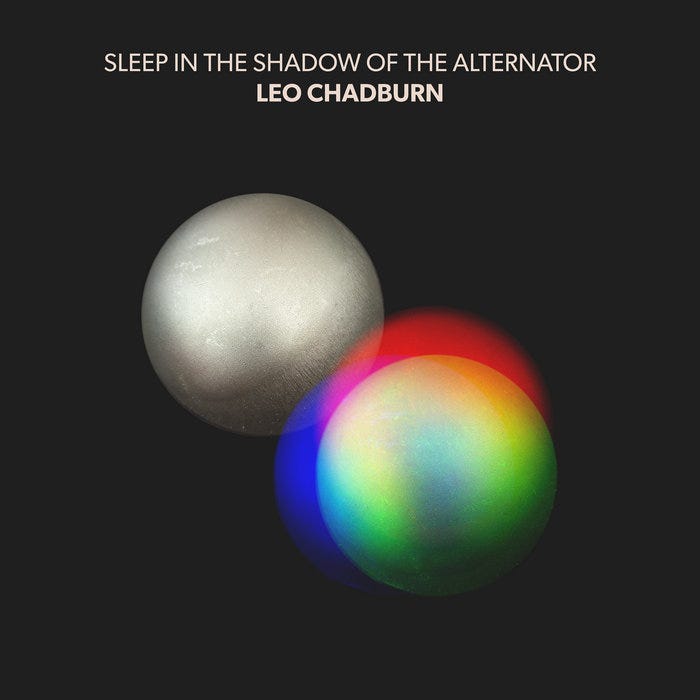
Voice, body, language, place: these have long been the central preoccupations – basic materials, really – of Leo Chadburn’s work, from his early releases as his avant-pop alter-ego Simon Bookish (‘Portrait of the Artist as a Fountain’) to the stream of recent releases every year or two since 2020 on his own Library of Nothing Records label: The Subject/The Object, Slower/Talker, The Primordial Pieces. For my money, Sleep in the Shadow of the Alternator is his best work yet, and the one to which so much of what he has made before seems to have been leaning.
It features many of the signatures of Chadburn’s music: the lists (of rock formations, local flora, occupations); the warm, disarming synths; the mingling of magic and pragmatic; a dichotomy of human and machine; and, of course, Leo’s own, misdirecting voice, mic’d in intimate, enveloping close-up. But on Sleep in the Shadow they come together in the form of something both bigger and more personal than anything else I think he has done.
In a review I wrote in 2020 of The Subject/The Object, I alluded to a resonance with Russell Hoban’s deep time dystopian novel Riddley Walker – set in a post-apocalyptic East Anglia several thousand years into the future, in which culture, language and mythology are still being built upon the deep-buried and long-forgotten symbols of the twentieth century. In Chadburn’s work, I heard Riddley in the simultaneity of ancient and modern – or the vision of a future that has been remade as though ancient. In The Subject/The Object there are also allusions to some terrible event in the past that has brought us to this moment: the sorry state of things; the town where we sheltered for the night; the dogs by the encampment.
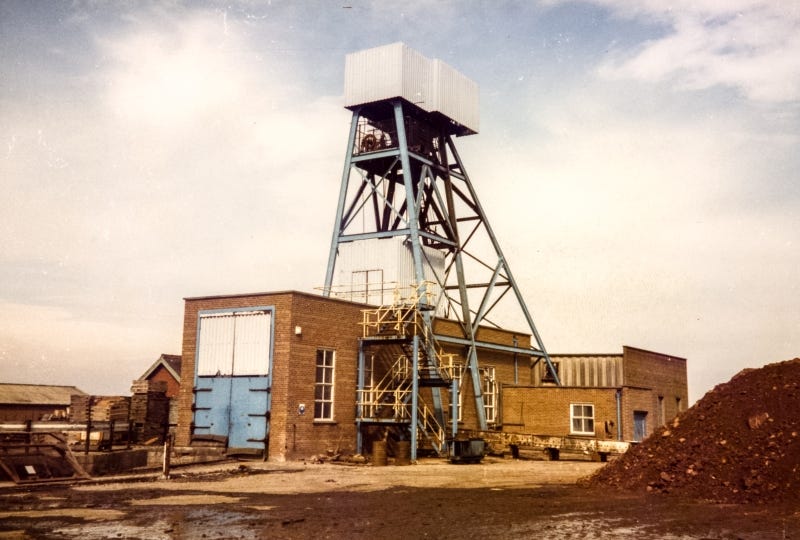
There is no such darkness, or not explicitly so, in Sleep in the Shadow. The work is on one level a memoir and a tribute to Chadburn’s upbringing in the coal-mining towns of the East Midlands. The four sections are tagged to different locations and times: the former Snibston, Whitwick and South Leicester collieries, autumn 2024; Charnwood Forest, between Leicester, Loughborough and Coalville, summer 1993; the Falcon Works in Loughborough and Coalville open cast mine, winter 1986; and Sence Valley Forest Park, northwest of Leicester, spring 3025.
However, a Hoban-esque atmosphere prevails. I hear it in the listing of medieval occupations – collier, farrier ostler, wheelwright, cooper, occultist. I hear it in the meditations on mining, geology and landscape. I hear it in the listing of magical flora and their properties. I certainly hear it in the final track, ‘It is a beautiful day (1,000 years later)’. And I hear it in the title itself, the alternator occupying a similar mental space to the Power Ring in Hoban’s novel – apparently some kind of ancient (ie, modern day) nuclear device located outside what was Canterbury.
Hoban represents a certain kind of English artistry of which I am inordinately fond. Trippy, occultist, alert to the nuances of plants and stone and seasons, and above steeped in our mongrel, absurd language. By extension, so does Chadburn. Often he has accomplished this through lists of terms or collections of found texts: The Indistinguishables (2014) for string quartet and pre-recorded voices offers a soundtrack to a list of seventy species of moth sighted in Britain; Freezywater (2016) for ensemble does something similar for the names of fifty topographical features encircling London; Affix Stamp Here (2016) is a song cycle based on messages found on picture postcards. And the lists of common and Latin species names in the second section, ‘Magic Flora of the East Midlands’ certainly share that space.
Going back to place, then. It is a site of history and culture. But it is also a geology, a climate, a history of industry and patterns of working the land, collections of lore, the timbre of a voice and the vocabulary at its disposal. Each of these feeds and shapes the others. And the essence of place is in the people who live in correspondence with it. Neither is fixed, but neither is foundationless either. This correspondence and intersection is what Chadburn appears to be getting at. The lucidity of his music opens the channels by which one thing can be shown to be an aspect of another: the lists of occupations flow out of the lists of native flora; the names of ancient trades flow into modern ones – incline winder, brakesman, projectionist; the trades flow into sounds and movements of a freight train, a turbine hall; and they flow into an efflorescence of vocabulary: torque, parallax, microfiche, pyrite, consortium … (If nothing else, Chadburn makes you want to write lists upon lists.)
This is a time of national head-scratching over what it is or means to be English. All too frequently, that scratching results in breakouts of hives and broken skin. But it seems to me that, in his own modest way, Chadburn has been exploring this question for some time, and coming up with much more interesting, more satisfying answers, ones that lead to fewer red and white rashes. Sleep in the Shadow of the Alternator is his most complex and complete statement on the subject so far, and it may be well-timed.
Also listening …
Mark Fell: Psychic Resynthesis (frozen reeds)
A lot of new composed music falls into one of two types: it is either tree or mobile. For tree, think Ligeti, or Grisey: music that defines its terrain progressively over time, discovering and developing as it goes. For mobile, think Feldman or Reich: music that defines its terrain at once, making discoveries by progressively altering or rotating. Mark Fell’s new album with London’s Explore Ensemble is that rare thing in that it isn’t really either. It doesn’t set out its complete stall at the outset; but neither does it accumulate or bloom as it proceeds. There’s a very real sense, as one instrument doggedly follows in the footsteps of the last, of an organism simply ploughing on.
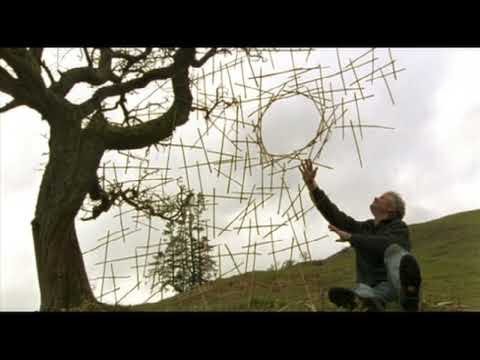
I’m not particularly concerned to know how these ten pieces were put together. I believe there are some statistical methods involved – suggested not least by the tracks’ subtitles, which each take the form of a string of numbers or pairs of numbers; The Wire’s Derek Walmsley refers to Xenakis as a background inspiration. The notes on the album’s Bandcamp page refer to the ‘selection of timbres and events’, which seems much more interesting to me, as though Fell were using Explore as a kind of sample library, and the composition as a sequence of triggers. (Fell is better known through his work as an electronic artist with snd and others; Nite Closure, the first release on his new label The National Centre for Mark Fell Studies, makes for a fascinating juxtaposition.) That puts a rather Cageian spin on things – sounds free to be themselves and all that – but Fell is evidently interested alongside that in building structures, albeit ones of the utmost precarity. There is even the briefest hint of a folk dance towards the end of Combination #3 (7|7|2|1|6|1). Unexpectedly, tenderly, it does all want to hold together. In the end, neither tree nor mobile, but somehow both; I was reminded of Andy Goldsworthy’s spidery constructions of twigs, impossibly cantilevered out into space.
Ian Pace: Michael Finnissy: Piano Works (Métier)
Four CDs is a lot of Finnissy piano music. I can’t pretend to have listened closely to it all yet. Why put it all out at once? Marketing, production, finance are the obvious answers, but often with Finnissy (and especially his piano music), it seems that bigness is the point. The History of Photography in Sound is the touchstone here: five and a half hours, some of it staggeringly dense music, an impossible brief (the history of photography … in sound? And for solo piano?), an encyclopaedic range of references. When Ian Pace recorded that piece in 2013 (across five discs, also for Métier), he accompanied it with a book-length sleevenote essay.
It was Rem Koolhaas who theorised that, beyond a certain size, ‘a building becomes a BIG building. Such a mass’, he continues, ‘can no longer be controlled by a singular architectural gesture, or even by any combination of architectural gestures. The impossibility triggers the autonomy of its parts, which is different from fragmentation: the parts remain committed to the whole.’
I’ve thought about this idea before in relation to Finnissy, and I’m minded to consider it again here. Certainly Édouard Glissant’s idea of the archipelago lends itself to a collection like this: asymmetric, dis-unified structures of parts; organisation through relation and exchange, rather than top-down control (Koolhaas’s ‘singular architectural gesture’).
Compared to HOPIS, the Verdi Transcriptions are both more and less sprawling, more or less big. Less, because there is an internal coherence to the project: transcriptions (more or less faithful) of thirty-six Verdi arias for piano. More, because each transcription is a fraction of the size of any movement of HOPIS. If that work is an archipelago like, say, the British Isles, Verdi is like that off the coast of Gothenburg, with its thousands of islets. Interspersing them with other works – the five Yvaoperas, English Country-Tunes (in what I believe is Pace’s first recording, and the first since the composer’s on Etcetera in 1990), and a fourth disc that includes Beethoven’s Robin-Adair, Brahms-Lieder, Strauss-Walzer and other pieces – only adds to the effect.
In numerous cases – take No. 23 from Book III, ‘Tradimento!’ – a cross-hatching of random (or more or less random) notes splattered across the keyboard encloses the transcribed material as though wrapping it in brambles; the Verdi seems to survive despite its transcription, rather than because of it. These are not really, or not only, transcriptions of Verdi but music about transcribing Verdi. Which involves questions of fidelity and creativity, of how to vocalise on a piano, orchestrate on it; and also how to engage with the long history of transcriptions of this music that already exists and how to continue that exercise. The fact that one could at all says something about the balance of artistic contributions involved.
The archipelago, then, is vast, and spreads across multiple dimensions. It is part of the point that you are meant to be disoriented, cast adrift in time and space. Yet ergonomics are what hold it together: there is still a body here, at the piano. When Verdi’s melodies and harmonies do occasionally rise to the surface, recognisable, they are played in front of the body, under the hands, in their original register. They contrast haptically (and therefore audibly) with the array of other figurations that surround them. An important aspect of Pace’s brilliance in this repertoire is his ability to hear these worlds within worlds as multiple and not as an undifferentiated plane of piano-ness. It is the bigness, the archipelago of detail, that brings this music alive.
Words elsewhere
Also dispatched this month: reviews of Liza Lim, String Creatures for Nutida Musik, and Catherine Lamb’s Curva Triangulus (another timbre) and Nathan Sherman and Alex Petcu, Archetypes (Diatribe) for Positionen; sleevenotes for Thomas Agerfeldt Olesen’s Violin Concerto (Dacapo Records, perf. Simone Lamsma), and Stephanie Lamprea and Alistair Macdonald, Ecstatic Visions (Neuma Records); programme notes on Julia Wolfe’s LAD and Fountain of Youth, and John Luther Adams’s Become Ocean, both for the BBC, and on Alex Paxton’s World Builder, Creature, Omri Kochavi’s gilufim and Sasha Scott’s, Sly, all for the London Symphony Orchestra; biographies of Wolfe and Adams for the BBC.
Glad to find you here Tim. Looking forward to more reviews!