
Purposeful Listening 11
Body/body

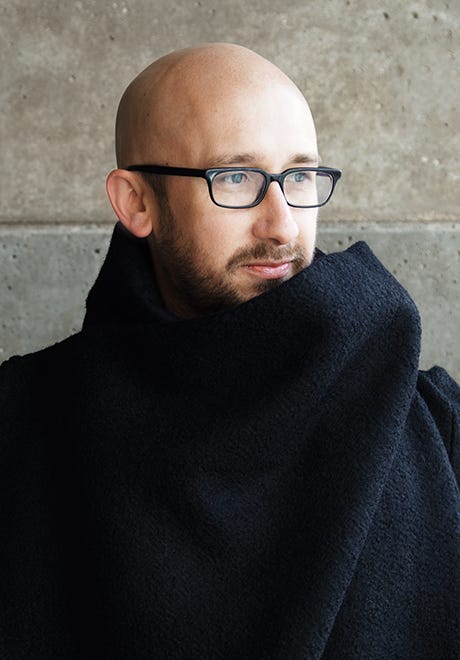
I’ve wanted to talk to Timothy McCormack on here for a while now. I’ve been following Ti’s career for a couple of decades now, since they were a postgrad at the University of Huddersfield back in the late aughts. This is the sort of thing they were doing then: a muscular, new complexity-derived style that owed much to the likes of Brian Ferneyhough and Klaus K. Hübler, but also to Huddersfield faculty members, Aaron Cassidy and Liza Lim. It was exciting stuff to hear from a composer still in their early twenties – ‘a fractal world of multiple, conflicting geometries’ is how I described it in a profile I wrote for the old place back in 2010.
This was, it soon transpired, barely the beginning of Ti’s story, however. Within a couple of years, they had already moved away from the demonstrative, declarative style of their early student works towards something less assertive, more contingent, exemplified by the pair of pieces Mirror Stratum and, especially, Glass Stratum. I remember catching these via, probably, a Facebook post of Ti’s when they were first written, and thinking, ‘Huh, that’s unexpected, but it also makes a kind of sense’.
Guided by a number of different influences – among them the ceramic artist Nishida Jun and, especially, the choreographer William Forsythe – McCormack pursued this path further and further, moving increasingly towards large-scale forms that tested both the physical and psychological mettle of his players (but which were equally prone to sudden and cataclysmic disruptions, like the limescale geologies that inspired his large ensemble work KARST). At Harvard, where they earned their PhD and which became their base after leaving Huddersfield, they took dance lessons (alongside their composition studies) with Jill Johnson, a long-time Forsythe dancer and collaborator; one of Ti’s most important pieces from around this time, you actually are evaporating, takes its title from a text by Forsythe.
Through the 2010s, McCormack’s music became increasingly engaged with the bodies of its performers, and the bodies of its instruments. We talk much more about this in the interview below, but significant landmarks on this journey include the hour-long quartet your body is a volume, for the JACK Quartet, and the truly epic WORLDEATER for trombonists Weston Olencki and Matt Barbier, which I have described elsewhere as ‘an immense organism composed of breath and lips and brass tubing’. 2021’s piano solo mine but for its sublimation, honoured on these pages at the end of last year, is also part of this story, a highwire act of piano resonance and delicacy of touch.
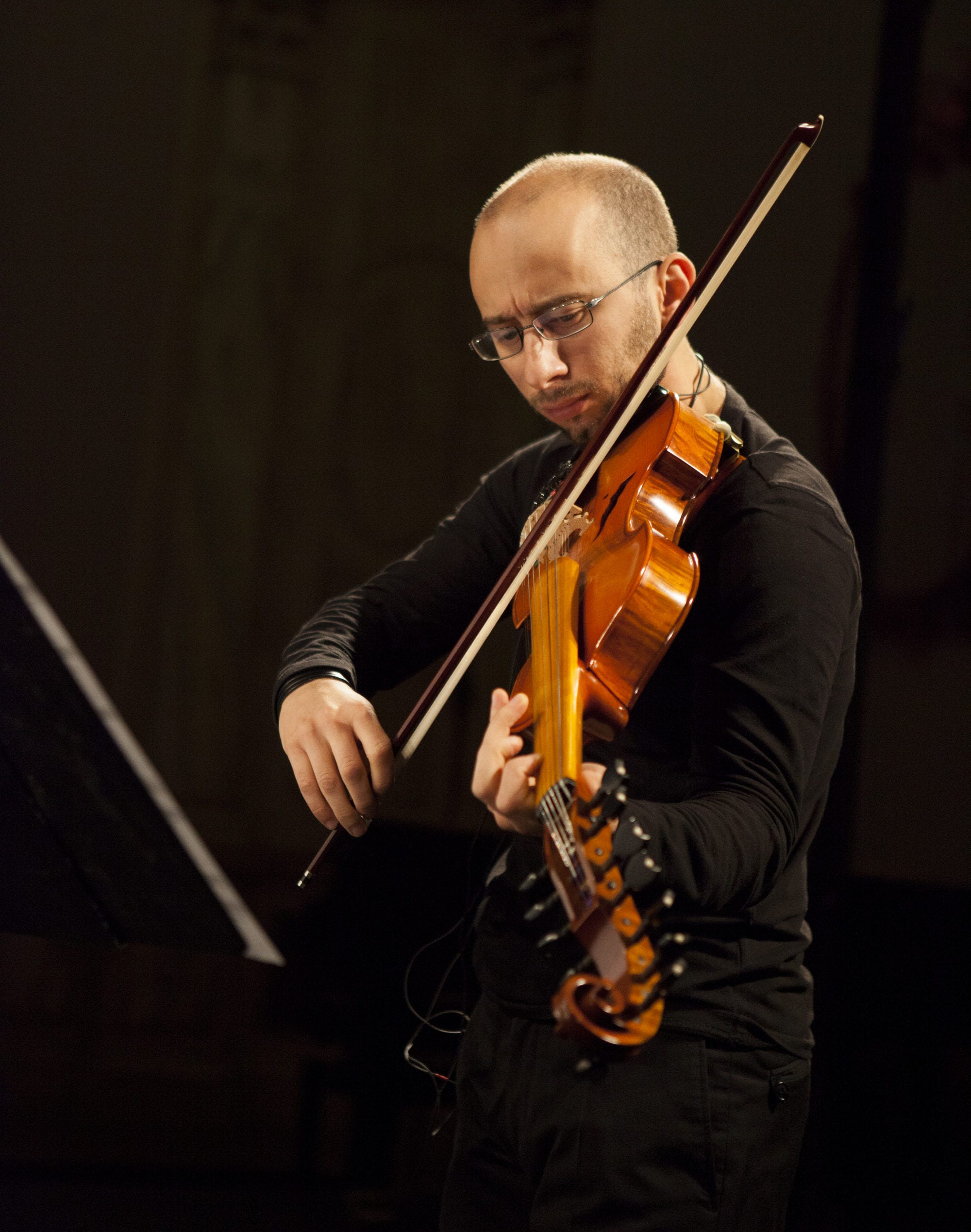
The interview below concentrates on Ti’s recent viola solo, … stretched across its axes – another vast span, at forty-five minutes – for the Italian string player Marco Fusi. Like many of Ti’s solo pieces, stretched arose out of a process of collaboration between composer and performer, so it made sense to bring Marco in on the conversation too. Ti spoke to me from his home in San Diego, Marco from his just outside Milan.
Readers in London will want to know that Marco will be playing this piece, alongside Yu Kuwabara’s Toward the Brink of Water Or the Verge of Dusk for viola d’amore, at City St George’s University on Tuesday 24th, at 7pm. Details and tickets for that concert can be found here.
TRJ: … stretched across its axes is a collaboration of sorts between the two of you …
TMcC: We’ve been talking about it for years; there’s been over a decade of buildup towards it. We always knew that it was in the future. So every time we were in the same place at the same time, we would check in on our interests and string research things and ideas for sounds – and then get dumplings!
And then, I don’t remember exactly why … It wasn’t the normal constantly deferred project; it was understood between us that there’s no rush, and when it wants to happen, we’ll just know, there will be something in the air – and that’s exactly what it was. I don’t remember exactly what the initiating thing was, but I remember it just felt mutually like now is the time.
So then there was a bit of a different charge in the air when we would see each other. There was a moment … we were at EMPAC [the Curtis R. Priem Experimental Media and Performing Arts Center, New York] at the same time. I was working with [violinist] Winnie Huang and [trombonist] Juna Winston on a recording thing, and Marco was there as well. And we had a much more, I don’t know, like pointed workshop. I think after a decade of this thing stewing in our brains, a lot of the material, or at least a lot of the fundamental technical ideas, were experimented with and set. And then after that, it was fairly clear what the piece was.
MF: Most of what Ti has said resonates with me and my memories – meeting, talking about this. What is very acute in my memory is how much we have grown from the first meeting to when we actually were on stage bowing together, because I remember talking about this for the first time when Ti was still at Harvard – and then afterwards having dumplings!
TMcC: And it was my first or second year at Harvard.
MF: Yeah, it could have been more like fifteen than ten years. And the thing growing organically and us being in touch. And then I proposed to play with some colleagues this piece for violin, Paetzold contrabass recorder and cardboard [The Chain of the Spine], and we performed it somewhere remote in Sweden …
TMcC: … the Kalv Festival ...
MF: … so there was a constant connection and rekindling of thoughts.
And then when we met at EMPAC, I also felt that was the moment when things came together. And they came together in a way that was, on the one hand, very reassuringly, successfully traditional in the sense that Ti and I played, or rather embodied, our roles. I was the performer touching the instrument, exploring and trying to find sounds, and Ti was there trying to capture these ideas, to structure them, to think how the little grains of sand that I was producing could be melted into glass.
At the same time, the beauty of these sorts of collaborations, in which, I would say, boundaries or rather rules and competencies are clear, is that you can really see when the two ways of thinking click together.
I remember moments where some sun was sparkling out of the instrument, when we were both like, ‘Oh my god, yes, this is it, we’re going to use this’. There is a specific moment around thirty minutes into the piece where a sound is generated by over-pressure of the bow, but also fingering up the string. That technique produces both a low grunt, like a hammering, like a growling sound, but also a high frequency, a high resonance and a high partial that is produced by the contact point of the bow on that specific point of the string. And I remember when we discovered that sound … we just needed to identify two or three sounds, and then a few months later, Ti came back with a quotation from Stravinsky, played with that specific technique. So it was quite interesting to see how that little sparkle exploded in the piece.
TRJ: Is that Stravinsky quotation in the piece?
TMcC: Yeah. This isn’t crucial for the piece, and it’s not compositionally located in a meaningful way. It’s just a little inside thing that leaked its way in. It’s a kind of bastardisation of a quotation. It’s not the exact quotation, but it’s this E-flat clarinet moment in the Rite. The morphology of that figure gave me a morphology for the figure of this moment that Marco was talking about. But it’s not the exact pitches, it’s the shape and contour.
The same could be said for Kurtág. There’s a recurring figure in the piece that is sort of a motive, so to speak, that is a sort of resonance or radiation of Kurtág’s Stele that leaked its way in.
In the piece, I don’t think there’s anything about these quotations that a listener would apprehend. They’re not really references. They’re just radiations off of these things that have been with me for a long time and that I think about and love. They just appeared in this piece – and again, they are not so much quotations. Rather, the morphology and the affect of these sources congealed something and made something clear for me within this piece. They’re cool and cute, but they’re not the foundation of the piece at all.
TRJ: To turn perhaps to one of those foundations, I know, Ti, that you work with, or think about bodies, and particularly bodies of specific performers. For as long as I’ve known your music – which is nearly twenty years – that’s always been part of the way you work. Presumably there’s some of that in the way that you’ve been thinking about Marco as the performer of this piece. Can you tell me where you are in that journey?
TMcC: Every piece that I write – especially a solo piece, but not just those – is sluicing two things together and is a confluence of these two things. One of which is: I have relationships with instruments, whether I play them or not. The first time that you write for an instrument, you learn a lot about not only the instrument but also your relationship with it. And what about a certain instrument exposes or clarifies or allows to emerge something within my own work. So every piece is a continuing sort of research/poetic project.
This is just to say that there is this string world that I’ve been mining for a long time. And of course, the deeper you excavate into a certain place, the more you realise is there. This piece really furthers the poetic, formal spaces that my work with strings for the past ten years has proposed.
But then also – and this is more to your question – a big part of that equation is the person that I’m writing for and what they allow: the knowledge and insight into their instrument, and the relationship they have with their instrument that they grant me access to. With Marco especially, he is a performer and a musician and a person who is very acutely sensitive not only to their instrument … You know, Marco is so analytic about his relationship with the instrument. We would be working and we would make a sound, and immediately, of course, I need to know: what are the physical conditions of this sound? And Marco is just immediately able to switch into this self-analysis, like, ‘Okay, what I did was this and it was this pressure, and if I move my finger in this way, it does …’. Which is exactly how my brain works.
When I want to use a sound, there’s a blockage between me and the possibility of using it, no matter how much I’m interested in it, if I don’t know exactly what is going on in the creation of that sound. I tend to try to analyse the production of that sound and determine what parameters – bow speed, bow position, finger pressure, bow pressure, all that stuff – what of that needs to remain constant? If you modulate one of those parameters, does one of those parameters break the sound, make it into something else when modulated? Or is the sound resilient through modulations of a certain physical parameter. In which case, I know that that’s the parameter that I can use to shape and create morphology with a certain sound.
That’s how my brain works, but on a sort of ‘removed composer’ side. And I got the sense that that’s how Marco’s brain and body work with the instrument as well – very analytical but also very poetic. I felt like we were able to bring each other through these spaces. From the analytical ‘Okay, just how is this technique? What is this sound? How is it being made?’ into this more poetic or formal space, ‘Well, what does this mean? How can we arrive at this place? What does it then allow for places for us to extend or or go? How can this sound be transformed into that?’ Which has immediate bearings on what the piece is: where it goes, how it moves through itself.
And so I just felt like we understood each other in that capacity. And knowing through working with Marco that he has such an immediate retreat into this critical-analytical relationship with his instrument … But also haptic; whenever these moments would arise in collaboration, it was never like, we put down the instrument, we talk about it; he was always thinking through his body in contact with the instrument. So I knew that with this piece, I could write really, really nuanced.
I mean, I guess I probably would anyway! [laughs] My music is pretty nuanced, I guess, but I knew I could really go there with this piece. There are a lot of passages in this piece where, yes, it’s a delicate balance to maintain the sound just right for this amount of time, but the degree of nuance that I could write and could trust Marco would attend to was really heightened.
We were just talking about this particular technique that revealed itself through us following a chain of sonic and physical situations that we were working on together. That’s one example. It’s a specific sound that is located only in this tiny little hidden corner, but once you access it, you can get on its frequency and vibrate with it and maintain it. But then there are passages that aren’t that sort of thing. It’s just the difference between, like, triple molto tasto and double-and-a-half molto tasto has some sort of vibrational, resonant shift in a sound.
There are minutes upon minutes of this piece, massive swaths, where really all he’s playing are open strings. But there’s still such a morphology and such an expressivity and an internal shifting to those, based on these really minute, really nuanced little shifts in bow pressure, bow placement … string tension is a really big thing in this piece.
Anyway, I felt with Marco that he was in a constant haptic feedback loop with his own instrument and always able to check in where he is and where he needs to go and how he can further sink the sound into a certain place.
MF: I was smiling while Ti was talking, because I think that most of my supposed ability to communicate about techniques and instrumental performing approaches really comes out of teaching: teaching the violin and explaining to students where you put your bow when you play a Mozart concerto, or other repertoire.
Obviously that is a bit more extreme, and the palette of those techniques becomes more refined in recent repertoire. One of the composers from whom I have learned the most in this specific area is Nono. And the way his desire for this mobility, this unstable sound and this exploration – especially in the last pieces – becomes so essential and so open, and so empowering of the performer without asking them to be improvising or doing anything different from what’s written.
So when Ti and I started working together, I felt this specific skill was very appreciated – the ability to express, communicate, reflect and show; or rather suggest direction for explorations in what they could do next after. Saying this technique is developed this way, it works in this register, I think, but maybe with a different string it can work differently, with more speed, or … And therefore, for me it was very beautiful, rewarding and exciting to see what happened after these little seeds were offered to Ti and the piece became what it has become.
Talking of bodies: although I’m familiar with this music, I’m not familiar with the physical experience of most of their music. I haven’t performed their string quartets. I’ve only performed the violin piece [The Chain of the Spine]. So I may be wrong in what I’m about to say, but my understanding of this specific piece is that there is another body that is being explored and has been exposed, almost, and caressed – that has been included in the dialogue in a meaningful way, and that is the instrument.
The instrument is celebrated in its own uniqueness, in its own ability to express and transform and translate itself into some other sonic world. And this transformation does not happen via an abstract reduction to an electronic device or an abstract insertion of pitches on the instrument – play this note, this note, this note … It really is made through altering the body of the instrument and the physicality of the string tension, and further enacting digital pressure upon those: touching specific points of the strings, pressing the strings down with the bow, finding the point where the instrument is not free to vibrate, is not suffocating, but is somewhere in between, where it is expressing sounds that become the new norm of the instrument, is accepting a new instrument, the body of the instrument in this new form.
And for a performer, who has been trained for ten, twenty years, on a specific instrument – and of all instruments, the string family is the one that has been more anally defined in micromillimetres, and performing technique is something that we’ve had drilled into our head since we were a child; like, this is how the fourth string should sound, watch Paganini – if you look at the fourth string of this piece, that fourth string is a different animal. It’s a different entity, it’s a different instrument. Its voice is wonderful. It’s fascinating, and it moves and moulds and offers. When we are talking about bodies and creatures and entities in this piece, the instrument is central.
TRJ: The idea of the instrument as a body and the performer as a body, and both of them in this entwined, touching relationship, and activating something in each other in the process of doing that – that’s a very erotic image on one level. I’m curious, Ti, how far you push that metaphor, the metaphor of the instrument as a body?
TMcC: I mean, I don’t really think of it as a metaphor. It’s quite literally the situation. Instruments are very, very complex objects, organisms; they’re not inert things. They have zones of … I don’t know. I mean, they’re constructed like our bodies: there are soft places and structurally firm places, and it’s all entwined together to make a thing that produces its sound. That is a super broad thing, but our bodies also contain multitudes.
So yeah, it’s not metaphorical, for me. What I’m writing for, in this case, a viola – not just a violist, but also a viola – it has an internal construction, a physiology, that I need to learn and that I’m in direct communication with.
Going back to what I said earlier: hearing a sound in somebody else’s music or, you know, hearing Marco improvise and produce a sound – it could be the coolest fucking sound I’ve ever heard in my life, but if I don’t know exactly how it’s being made, I have no interest in it.
It’s not even like, ‘Oh, I can’t write for it’. I literally don’t really care about it until I know how the instrument produces it, or what the situation is between the performer and the instrument in producing it. That’s when it becomes alive and a real thing for me, once I understand how the thing makes it.
It’s not just a technical, ‘Oh, now I know how to write for …’; it gives me information about the instrument’s body and how the instrument is constructed in how a certain sound is placed within my knowledge of that instrument’s body and its expressive potentials. It’s in communication with all the other things that I know that that instrument can do because of this, this, this and this …
Again, I don’t see this as a metaphor: it’s quite literally the situation, this reciprocal touching and unlocking or exposing or whatever that the performer has upon the instrument or that the instrument has upon the performer. There’s an agency that instruments have just as obviously as performers have over each other. You know, instruments are constructed to fit upon our bodies in a certain way, and there are specific places that we physically touch and thus connect to an instrument. And in those moments, the instrument includes us in it, and vice versa.
That objective fact is really generative for me, but there’s also a poetry of that. There’s a choreography of that connection, of those sites of touch and mutual expansion and exposure. And that’s really the locus of my work. It has been for a really long time, but that has meant different things, or it has become different things over the years. And with every piece, and especially a solo piece, I think my goal, at least initially, is to figure out what those locations are for the piece.
The piece has an agency as well. We think, or maybe people think, that a composition is a thing that is being created. You know: it’s ephemeral and it’s invisible and it doesn’t exist until you create it, and at the double bar line, it’s there. But for me, that’s not the case at all. We’re talking about the agency and the presence and the reciprocity of the performer and the instrument. Those are objects that presuppose the piece, but also the piece – even though it’s not a thing in the world yet – also presupposes the situation in a way. It also has an agency in its emergence.
There is an aspect of discovery and not quite knowing what something is until, you know, Marco and I have done x amount of time working together, workshopping ideas and techniques and stuff. But there is also a sort of traction that the piece exerts, before it is created. It’s difficult to articulate, but there is a thing that I have a sense that the piece might be, and it’s reciprocal with all of the work that we’ve done, in a more ephemeral but paradigmatic way that the body of the performer and the body of the instrument are reciprocal – they touch each other and in finding the nodes of touch there’s an unlocking, a discovery in in finding the right ones.
So even as the piece is emerging, before it’s a thing, those nodes, those places of reciprocal touch – the piece is part of that as well, of finding that triple node where a sound between, you know, the instrument and a person, but then also the formal and poetic requirements or requests of the piece … those three things locked together. And that’s why some pieces are different than other pieces, despite the fact that there is an ongoing interest in research in certain techniques and sound worlds of string instruments that I carried into this piece. But this piece is so different from any other pieces of mine that also start from within that same current of research.
A piece for me is largely navigating and trying to sense amongst all of the work that Marco and I have done on sounds and techniques, and thinking about these various bodies and the places in which they intersect. But a large part of the piece, especially the early process, is very slow because I’m also trying to sense when and in what concrescence of these things does it then feel like it’s sinking into the piece. It’s like walking through the woods at night, not being able to see anything but knowing that there’s a swamp or a sinkhole and wanting to sink down into that. That’s the substance of the piece, and we’re carrying all this potential material and potential experience through it. But once it unlocks a place that you feel like you can sink into, that’s the zone of the piece.
TRJ: I want to come on to the role of duration and length in this piece and how that how that interacts not only with the physical aspects of playing it but also this idea of becoming that you were referring to, Ti.
But before that, I want to ask: the way you’ve described the process so far is that you and Marco were working together, and you were finding sounds like this grumbling thing with the high harmonics, going ‘Yeah, that’s got to go in, that’s a landmark in this piece’. When you go back to your desk, with a whole load of these landmarks, how do you turn them into a continuous piece of music? Is it a matter of finding the transitions between those landmarks, or creating a drama out of them?
TMcC: I mean, again, it’s a sort of negotiation: you know things, but you don’t know things. I think one of the most difficult aspects of composing is having all this knowledge, having all of this history, having all of this loaded material. Marco and I generated all sorts of things … and it’s not even – at least the way that we work – ‘Okay, we have this technique and we have that technique’, it’s like, we understand the properties of this reciprocal physical haptic situation that’s going on with the instrument. We understand the specific zone or zones that we’re exploring. And we’ve mapped it out, or we’ve learnt it to a degree that we know that within the zone there’s that place and this place, and if you push in this way, it becomes that thing, etc, etc.
So there’s this knowledge. And then within that knowledge, there’s a network of understandings of potential material and how they can be related to each other, either formally or physically – by which I mean, I know that this sound can transform into that sound, by way of this physical operation, and I can use that.
The zone of composition is informed by all of that, but it also has its own agency. And I think one of the most difficult things about being a composer, or rather about composing, is that you have to both hold and contain and be mindful of all of this material and all of this information and knowledge that you have generated, but then you also – or I also – have to be at every step very attentive, attuned and open to the piece itself. By which I mean – especially as you write it – there’s a point at which the piece that you’re writing, even though it’s this emergent thing that doesn’t exist yet, it does sort of know something about itself that I don’t.
There is always a point or points where the piece itself starts to talk back to me. And it’s very difficult to … you have to be flexible and open and vulnerable enough with oneself, I guess, to actually hear the piece when it’s talking back to you. And then I also have to be flexible enough with my process: I might have a plan for the piece, but it starts talking back, and in order to be responsive and open to those moments, I also have to be flexible enough with myself to let go of plans that I had or places that I felt that the piece might go. And that happened a lot with this piece, much earlier in it than I had also anticipated.
The piece is sort of a diary of its own making. In this piece, but also in a lot of recent work of mine, the beginnings feel, in a metaphoric way, but also – again, this is all very real to me! – they begin in a place where the piece itself is waking up. It’s an organism that’s just coming into being and very, very slowly learning about itself, learning that it has extremities, that it has arms and legs and appendages that can move. And once it realises that it has those and they can move, then there’s this learning that we hear happening in the piece of not just that it can move, but how it can move.
And in this piece, we hear that. The beginning is at once very diffuse and very indistinct, but at the same time, it’s … I mean, it’s the most difficult passage of the piece, I think Marco has said multiple times. [laughs] It’s also very specific, despite it feeling weirdly diffuse. But then – and this is getting to this idea of the piece talking to you – I was, again, very surprised – this was not the plan – but it actually reaches a clear statement of itself much earlier than I thought initially would make sense; you know, this idea of the piece waking up and learning of itself. It’s not that deep into the piece before we get an interval and a very harmonic kind of solid statement of a thing.
Going back to your initial question about duration: yes, duration is really, really important. I think of it more as scale. There’s a scale of time, I guess, of proportion, that’s really crucial to hit with this music because, yes, there are pivot moments. Those pivots can have a duration in and of themselves – or sometimes they’re actually on a dime. But if they’re not anticipated, once they happen, they need to feel inevitable – it’s not being able to anticipate a place, but once we’re there, it feels inevitable that we were going there. And in order to achieve that, it’s actually not just about those moments and the specific shift or balance of those moments, it’s actually about everything that came before and how long we are with what, what the rate of movement is and for how long.
So I think a lot about how much time – and the proportions therein – that certain materials need to emerge and learn about themselves and understand themselves. But then also sometimes, once they’ve established themselves, once the piece has learnt a certain thing about itself, to then sit with it and be with it. It’s not just a state of constant unravelling of emergence, it’s also important to have places that are sustained and maintained with that knowledge.
And so there’s a constant balance of proportion and flow and energy. I think a lot about too little material occupying too much space, and then the inverse. But it’s never just a formal game. I always hope, if not in the moment, then at least eventually or in retrospect, that spending that much time with a certain thing prepares our ears for this other thing.
MF: I think that the way Ti and I worked on the piece was particularly significant in that direction, in the sense that once the piece was completed, we didn’t have an awful lot of time together. The very first meeting we had [about the finished piece] was on Zoom. And I remember we only scheduled 45 minutes, which was the duration of the piece!
And in my own way, that was probably unexpected and borderline rude, I assume, I forced them to speak about the piece for a good part of those forty-five minutes. That is, telling me not just what is this technique or that, because I was familiar with the writing and with the technique, but what’s the story? What is the direction? What is the meaning in the general structure of what’s happening here? And what is the body of the piece doing, why is this point so static and why suddenly is it flashing to me?
So there is another wonderful moment in the piece where a sort of tentacular creator flashes towards you and tries to get closer, and this sort of gesture stays with me. I wait for that moment for a good thirty-five minutes at least. Or at least I know that that’s about to happen.
And this idea, this structure in time, is to an extent what drives the performance. It is a transposition of … you know, when you learn how to play an instrument, you are always taught to read the next note, not the one you’re playing. On an incredibly different scale, this is the same situation. To be at my best, I would want to know before the performance that I’m entering this line, and I want to know where I’m going, where my trajectory is going within a certain amount of time. And with that in mind, I know where I can slow down even more when I can … not necessarily play with time, but play with the listener’s expectation in their time and keep them static for an insane amount of time, with the promise, or at least with my own word, that something is about to happen. And that sort of calm and static acceptance of time passing and remaining in the same situation is what forces people in the audience, and myself, into understanding even more when things change and these pivotal moments when these firecrackers explode.
Again, as a performer, that is a strategy that you use often. You slow down, you play the crochet in the last second – but on such an enormous scale, such a wide breath of time, it is something that becomes almost a promise more than something that is perceived. Because when you are forty minutes into the piece, the fifth minute still counts, but in a way that you don’t remember anymore. You’re living through the situation, you’re getting close to the end, you’re exiting.
And if I can rebound on something that was mentioned briefly before: the idea of sensuality and physical contact with the instrument. That is a metaphor that is very relevant for Romantic music, for a lot of music that has this sort of a flame, this burning passion that is ingrained into itself. I always make jokes about playing more than one instrument and not being, you know, a monogamous person, or other jokes about, yes, but I’m doing it on stage for way too much time ... [laughs]
So there are things that reveal the limits of the metaphor, but what I think remains interesting is that in most situations, or in the best situation, I hope for, you know, deep, physical, emotional and sensual connection. There is with another body – whether that is human or not human – an aspect of wonderful and deep knowledge of each other. That is what remains, and that is what allows you to go on stage with your instrument partner and to be able to perform that, to play the piece in a way that becomes believable because you both know how to act in that situation.
You both know it’s not the same when you’re in the practice room or in the bedroom, but it is very much something that you know so well how it goes with them, that you can show it to somebody else. You know, when you can drive them and tell them: you see, I’m doing this, I’m doing this gesture. Now I’m touching it here. And this is not a casual point. This is exactly what’s happening in this piece. But I think it’s not only sensual, it’s a deep and embodied knowledge of each other.
TMcC: If I can just add a few things that I was thinking about off of what Marco said, just to bring it down to earth – because I’m talking like, ‘Oh, composition is this cosmic thing …’.
It should be said that this is a forty-five minute piece, and Marco’s body – fingers, chin, arm, with the bow being an extension of his arm – is in contact with the instrument that entire time. That has repercussions. I don’t think that there’s any moment where you’re allowed to just, ‘Okay, off that, and now the next situation or the next place that I need to be …’
TRJ: It’s a continuous situation.
TMcC: … It’s a continuous situation. And if the bow needs to be at a certain place, at a certain pressure on a certain string, and the left hand needs to also be at these various very specific places, it’s not just a resetting there. It’s a haptic … from one very specific situation into another, but through, in that transition, through many others, that are being made in communion with the instrument, constantly in touch with the instrument. Which also means constantly making sound, so all of these interstitial physical sensuous, intimate ... I mean, it’s very, very intimate, and it’s also very, very vulnerable because every touch, every quality of touch that Marco has upon the instrument, is then heard. There’s a vulnerability to that, and that’s happening for the entire forty-five minutes.
One more down-to-earth thing off of what Marco said. Just going back to the idea of time and duration: Marco was talking about how long some of these trajectories are, which is important. I mean, there are passages in the piece in which a single phrase, from start to finish, could be five to ten minutes. I mean, it’s a contoured, nuanced thing, so there are smaller places and shapes and trajectories and morphologies within that, but it’s a line that needs to be kept taut, that entire time.
When a phrase goes to that level of time – and again, Marco is in physical contact with the instrument that whole time and needing to transform very slowly from one state or situation to another throughout that, and it’s taking place at that level – it induces a very, very different sense of time and sense of form and trajectory, not only in the listener but also in Marco as the performer. Knowing that, ‘Okay, I’m pushing through this place and eventually this is going to connect to that place’. And for the listener, it may take some time for the piece to sort of induce this sense of time, but it does eventually shift our relationship to time and our relationship to flow of event, rate of event. It changes one’s listening, and I think you sort of forget about time. But at the same time, your attention is really with every moment of the piece. So it’s a sort of double expansion.
The physicality that we’ve been talking about, this sensuous reciprocity, the instrument in the body being one thing, but also mutually exerting a knowledge upon each other and the sensuousness of that – that is directly connected to time and scale and proportion and duration. They’re not different things to me.
The sense of time is accessed through this particular state of physicality; but also, it is that time, that expression or that sensation of time, that informs the rate and proportion of gestures and phrases and physicality. So again, it’s a reciprocal thing. It’s not just like, I want my pieces to be long and slow and so I’m going to write drones that last for a long time. It’s much more of an intimate entanglement between the two things, just like the instrument and the body, and the piece and the instrument and the piece in the body – just as they exert a mutual contingency upon one another, I also see that between the quality of sound and the physicality that goes into that, and this temporal sensation.
TRJ: I wanted to ask just one more question. Marco, we’ve all talked about this idea of two bodies corresponding and engaging with one another, and that being a process of discovery. And that’s the fun thing, that’s why you like to take time over these things, so that you can discover things.
But I’m wondering, when you’re actually on stage, playing this music – not so much when you were making the piece together, but when you are actually doing it on stage, and you’re working within what sound like very, very small margins of possibility – is that sense of discovery still possible?
MF: [pauses] So as a good PR, I would say, yes, of course it is. And as a more honest person – I don’t think PR people are honest – as a more honest person or musician, I think, yes: to an extent. The extent being both the contingency of the performance and the degree of freedom that I feel I grant myself or that the situation grants me.
For instance, in a very silly way, if you premiere the piece in an important festival, I hope that things work out as best as possible, but I’m also very mindful of not ruining anything. So there is a degree of familiarity with the piece, a familiarity with the scene. In a recording situation, I would feel more comfortable exploring more because it’s not live.
In terms of physical interaction with the piece and with my body and with the scene and with the audience, there is a degree of tiredness that happens throughout the piece, because the concentration and the tensions that need to be exerted are very high, the attention to details, and attention not only to details that have to do with sonic production but also to do with your own incarnated experience, your embodied experience meaning.
I know how my body and most bodies work when playing an instrument, and I am aware of a sort of crystallisation that starts to happen where things move less and less and your knees lock and your elbow and your pelvic floor moves in a certain way, your breath becomes shorter, your neck becomes stiffer. And I am aware that this will happen in the course of forty-five minutes. And when I am almost there, and I’m almost solidified on stage in this sort of tension that I can’t breathe out anymore, that’s when things become more difficult. But significantly, that’s also when this piece changes and unlocks completely. Techniques change dramatically at a certain point, which is to my own physicality, specifically when I’m about to crack.
So, I think the discovery has to do with my own well-being on stage, my own confidence on stage, and the degree to which I think I can afford and risk on stage, as well as my own actual physical state. How I’ve got off the plane before. How in tune the instrument is.
That’s a problem we recently had – a discovery, let’s put it this way, that we had when we premiered the piece in San Diego, given the room and the tension and everything else. The tension of the strings changed throughout the piece, and therefore I had to actually act when I was supposed to play open strings to correct the tuning, to finger things so that I could actually obtain the pitches that Ti has written.
Anyway, long story short: every performance is a process of control and allowing freedom, and this happens in different situations, at different moments in time.
The virtuosity here is very much an ‘underwater’ virtuosity. When you have to preserve your breath for as long as possible. You are in apnoea, and then with that you need to be able to do wonderful dances and movements and sounds, but preserving your oxygen until the very last molecule.
TRJ: It’s like the discovery that you get from running for a long time, but not in a completely solipsistic way. That discovery then becomes how you’re making the sound that we hear.
MF: Yes. Also, in terms of solipsism and performing for oneself versus performing for others: there is a bit of both. Because you want to assume that the audience is following you, and you do all your best to have the audience following you.
However, if somebody isn’t connected because they’re not on the same wavelength, it’s definitely not a Paganini piece where you can, you know, do a couple of left-end pizzicato and people get excited. That’s where you are, you are stuck with this sound. So either you come to me or I am playing for myself.
And it also depends how people perceive time. Everybody has a different perception of time in the moment of the day or in the moment of life. For me, right now, it’s very interesting how I’m very conscious of time when I’m not performing. When I’m teaching, when I am talking to people, I know exactly for how long I have been doing this specific thing. However, when I play, I honestly can’t tell if I’ve been playing for fifteen or for forty-five minutes. I don’t know.
So the idea of drawing the arc is an intellectual way of knowing that it’s going to be long. But this is also what makes me feel when I’m delivering this second, I know where I’m going; but this second is as important as the next second, which feels the same. I don’t know if I can explain it better than that. It’s a presentness in time that means the trajectory is being built one step after the other, each trying to have the same quality and presentness.
TMcC: I want to add something to that. First of all, there is a pretty crucial left-hand pizzicato in this piece. One: so that’s the Paganini reference, I guess! [laughs]
But what Marco was just talking about – my way of thinking about it … As I said earlier, this idea of the instrument and the performer being this mutually connected, entangled organism, that’s been with me for a long time. That’s been the locus of where I begin my music for a long time. But as I said earlier, as you excavate a certain plot of land, you just discover more and more.
So even though this place has been with me or this starting point has been with me for a long time, obviously the music that has resulted from it has really changed. And along with that changing of the music has been a shift in what physicality means or what type of physicality is being called upon. This is just to say that back when you did your 10 for ‘10 profile on me, physicality was really important in my work at that point, but the type of physicality was a very demonstrative and extroverted physicality. It was the physicality of atoms crashing and energy is put out.
My work has shifted over a long period of time, but we’re now at this place where the type of physicality that’s being called upon between a performer and their instrument is a very hidden and retreated physicality. It’s not necessarily so evident to a view, but to one’s ears, you could really hear it. And for a performer, it’s inescapable.
And so the music that I’m writing now, the type of physicality that a performer needs to access – or what they need to do with their body – they really need to be centred the whole time, very centred and sunken into and attuned to every movement that they’re making every. Not just movement, but the force of every finger, of every bowstroke, etc. And that requires a centredness of oneself that doesn’t necessarily display itself in the same way to an audience, but I think there’s a charge in the air. It’s very … tense isn’t the right word, but intense, a palpable quality of physical attention and physical intelligence that Marco is having to maintain because there’s really no other choice. Maintain, embody, be mindful of, etc. There’s a soft energy from that that is really, really palpable in the hall as well.