
Purposeful Listening 14
Loose/bound

I first encountered the British-Iranian composer Soosan Lolavar in 2020. Quite early in the pandemic, Riot secured funding to commission and record solo pieces by six composers, which we would then release as streaming videos. They were made in collaboration with the online gallery Zeitgeist, and initially it was a way to make work and to keep things ticking over in our own small way while the world tried to right itself. Eventually, the project expanded to several dozen compositions, drawing in commissions from universities, hcmf, the PRS and more. Many of those pieces have made it into our players’ regular repertoire.
Anyway, the composers from that initial group were all from that year’s call for scores shortlist. Once we had the money to make the commissions, it was simply a case of players putting their hands up to request who they wanted a piece from. The brilliant violinist, Sarah Saviet, wasted no time in tagging Soosan, and the piece that came out of that partnership, Undone, has gone on to be one of the most successful works of the whole series. As we’ll get into in the interview below, it was something of a turning point for Soosan’s music, marking a new moment on her journey into her own double consciousness as both a British and an Iranian artist. It also spawned a little star system of related pieces: a four-part work, Every strand of thread and rope, for solo violin (recorded by Sarah for all that dust in 2023), of which Undone forms the second movement, and a concerto-like orchestration, also called Undone, for soloist and chamber ensemble. The ensemble version was recorded for Nonclassical in 2024 by Saviet and Ruthless Jabiru, conducted by Kelly Lovelady, and nominated for a 2024 Ivor’s Classical Award in the chamber ensemble composition category.
My small part in this was to ping Soosan a handful of generic questions about her piece and her experience of lockdown (as I did for many of the early Zeitgeist composers), her answers to which we edited into a couple of accompanying videos. I was struck at the time by her answers, which neatly tied together not just the playing conditions of her work, its background and its relationship to her Iranian heritage (via her use of a santur, a type of Iranian hammered dulcimer, to generate its tuning system and some of its material), but also her present psychological state and the conditions of the world at that moment.
Fast forward a few years, and I next met Soosan at Juliet Fraser’s eavesdropping festival in 2024. There, she gave a talk as part of the weekend’s forum component under the title ‘Notes on Failure’. In it, she talked at length about Undone, the process of making it, and the pieces that had come out of it since. But she also talked about her recent, and ongoing, struggle with cancer, how debilitating it had been, and how it had forced her to find a new, more economical and less draining way to compose. Some of this manifested in her new-found propensity to reuse or elaborate upon her own material; some of it came through in the greater sense of looseness – occasionally bordering on improvisation – that she had begun to admit into her work. Suddenly, to the dimensions of Undone she had already talked about in 2020, was added yet another, perhaps the most consequential of all.
All of which is an intoxicating set of ideas for any music critic to get their teeth into. Yet somehow it took me another two years to set up a proper chance with Soosan to dig into them more deeply. As I hope is clear, the US-Israel war with Iran had nothing to do with my wish to talk to her about her music, yet it inevitably cast a shadow over our conversation. We spoke on Thursday 9 April over Zoom, two days after the US president threatened the total destruction of Iranian civilisation and only the morning after a fragile ceasefire of sorts was brokered. Soosan’s father is Iranian and she has extended family in the country; I am therefore extremely grateful to her for still wanting to talk to me, and for the generosity, humour and insight that she brought to our conversation. I deliberately left it to her to say what she wanted, if anything, about the war. In the event, we didn’t go into it much, but as you’ll see, her diasporic perspective is deeply interwoven with her creative practice.
Soosan’s music can be heard on Every strand of thread and rope, released on all that dust, and on Girl, released on Nonclassical. Her book, which we refer to a few times below, is Disrupting Diaspora: Embodied Research through Music Composition and Evocative Life-Writing, and it is published by Routledge.
Interview with Soosan Lolavar
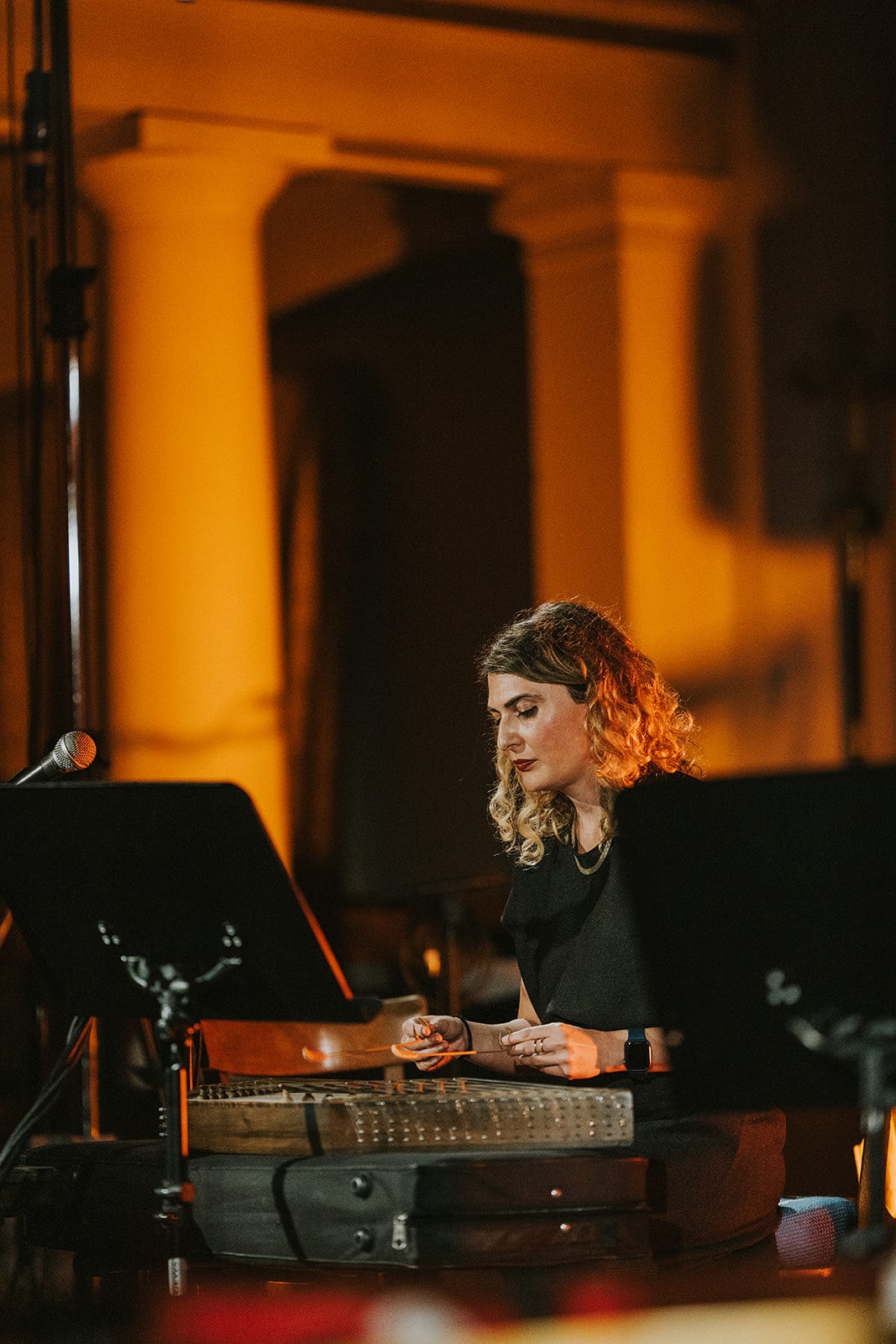
TRJ: Your music has a lot going on in it, and hopefully we will come on to some of that. But I wanted to start with Undone, if that’s okay. Partly because I think that’s the first time I really became aware of you and your music. But also – and tell me if I’m wrong – it feels like it’s a kind of turning point or a pivot of some sort.
I wonder if you could start by explaining how you see it as a pivot: what were you doing before then, and what afterwards?
SL: Yeah, I feel really connected to that piece. I love it and that set of pieces, and I think you’re right. It is a turning point.
I think that was when I started to really loosen my relationship to technique … I never wrote complex music, as it were, but there was a lot of detail, and I was often trying to explore things in a very clearly thought-through way, trying to add lots of intricacy. And then Undone – slightly facilitated by the fact that it was just for one instrument – was just where everything started to loosen. And that is both literally: I did this detuning, so the violin was really loose; but my control over things started to really loosen too.
The four pieces on that album range from totally written to really vaguely written and with a lot of improvisation. Undone probably sits in the middle. And it was written first. I think it’s interesting that it’s the one that opened up the spreading in each direction.
I think it was partly that I had finished or was coming up to finishing my PhD, and the works in that had been about this gradual loosening of control. But it was also working with Sarah Saviet, who’s a really amazing violinist, a really, really accomplished improviser and just a very giving and generous performer. So yeah, I started to loosen control of everything a lot. And I found that the kinds of things I was interested in came much more to the surface when I just let go a little bit.
TRJ: And was it the first piece in which you used the santur as a compositional tool?
SL: It probably was, actually. That was partly because it was lockdown, everything had gone a bit weird. I was in my house, couldn’t really go anywhere. Maybe that forced me to be like, OK, what can I do just here by myself? And then that opened up this whole new way of working, which has persisted since.
TRJ: I know that the tunings that you were getting from the santur were very important in the violin piece.
SL: Yeah.
TRJ: … Whereas before – I don’t know all your music before this – but it strikes me that it’s more written in equal temperament.
SL: I’d use the odd note here and there. But yeah, probably more or less everything was either equally tempered or it was in an Iranian mode. Iranian modes, although they don’t use the twelve notes, they’re very fixed. They’re very solid. The tunings in Undone are pretty random, actually. I think I was just tuning my santur and fiddling around, and I found a tuning that I liked the sound of and then measured it all with a tuning fork. So it was very instinctive. But as a result, it has this kind of instability, which really feels like lockdown to me. [laughs]
TRJ: You said something about that on that video you did for Riot that it was the undoing of not – as you say now – a kind of control of the music, but more a general social undoing.
Since then, you’ve started performing on the santur, and it has become a much more central part of your musical practice. How is that folded in with the double consciousness idea that you talk about in your book – this dual identity as both British and Iranian? Because that is one of the central things that you are exploring in your music, right?
SL: Definitely. And the journey I’ve gone on with the santur really reflects that, I think. I started playing it ten years ago, when I went to the US to study Iranian music. There was also a santur teacher there, in the community, and the guy I was studying with basically said: you need to buy a santur. So I got one shipped over from Iran. I didn’t have a clue what I was doing; I had these very austere and slightly terrifying lessons with this guy who every week was like, I cannot believe how bad you are! [laughs]
For that year, I studied the Radif. It’s what you study in Iranian music. It’s a collected volume of about 300 melodies that are divided into these twelve modes, and you memorise them. They are notated, but you can’t use the notation to play from. That’s just to refer to, and really, the notation is so unhelpful that it’s much better just to listen to them.
Then once you’ve memorised all of them and can recognise them and move between them – you know, understand them really well – then you use them as the basis for improvisation. You would never play any of these melodies in performance, it would be like playing a scale. They’re a kind of route to performance.
Anyway, I did this for a year, and in a year I learnt one of the twelve modes, but not even that well. Because I was mostly doing composition, this was a side thing, but I found it very difficult and dispiriting and didn’t really get into it. And when I came back [to the UK] I put the santur away and ignored it for a bit.
And then a project came up where I thought, oh, maybe I’ll give it a go. It was a thing with a dancer. I watched that piece again the other day and it was interesting, because I definitely had limitations – massive limitations in terms of technique – but I guess the composer in me had found an interesting way around them.
I also had this massive, massive fear and anxiety about being allowed to play this instrument. It felt very Iranian, it felt very traditional. It felt very like the kind of thing that people like me – i.e., these middle, in-between, double consciousness people – aren’t allowed to do, and you’re only allowed to do it traditionally. And people did say to me, ‘Why are you playing it weirdly? It’s not very good.’
In that period, I had quite a violent relationship with the instrument. I prepared it, I tied strings to it. I attached paper clips and safety pins. I really bashed it up, actually, and I think there was a desire to slightly damage it, maybe.
And then gradually over time that relationship has loosened – still being really interested in those kinds of prepared things, but just feeling like I’m allowed to play it in any way I want. Exploring that has really made me reflect on … This is not a new idea, but Western classical – all classical music, not just Western, Iranian, all different kinds – is obsessed with a singular ideal type of sound. And this idea that to be good is to do this and to be bad is to not do that. To greater or lesser degrees. And actually, there’s loads and loads and loads of music in the world that just isn’t interested in that, or in which that just isn’t a factor. It has been interesting that that relationship with the santur has allowed me to unpick that in Western music, and in other music, and to start to approach things from this different view of not perfection but more community and experience and exploration. What is new, what is interesting to me and what is expressing what I want to say?
TRJ: From the Western classical point of view, that’s the Lachenmann thing of, let’s look at an instrument. Here’s what it’s supposed to do: let’s amplify all the stuff that you’re not supposed to hear. You know, key slaps and breath and all this, and dig into that. It sounds like you were doing similar things with your santur: finding what it did that wasn’t the ‘correct’ thing to be doing with it.
SL: I think when I started, I can see that I was still really firmly based in this European new music tradition, so I was definitely doing what you describe as the more Lachenmann approach to things. The kinds of sounds I was aiming for had a new European new music foundation, for sure. Because I think that felt familiar to me; it felt safe.
It also felt like it would be taken seriously if I followed that route. Which is a great route still, but it’s interesting that that has massively loosened now, and I don’t feel the need to make the santur sound new and modern and contemporary and difficult. It’s almost as if when there was tradition, it felt like my option against tradition – or to not be within tradition – was to be new and dangerous and contemporary. Whereas now I don’t feel I have to.
It’s having that confidence in Iranian tradition, but that’s also another tradition that I’m being tied to a little bit. I’m feeling slowly, slowly a bit more confident to just do something that I want to do.
TRJ: It sounds like as if, to begin with, your relationship to the instrument had an almost Freudian side to it. Like you say, you had to bash it around. You had to come to a familiarity with it in a confrontational kind of way.
That’s your point of view. Thinking of the instrument as a living thing, has it come towards you in a similar direction?
SL: I think so. I think we’ve come together. We started as this slightly antagonistic pair, and I treated it quite badly, and it felt difficult and uncompromising and remote. It was almost like – and this echoes my life a bit – it was this bastion of Iranian culture, and I was a teenager rebelling against it.
And then it’s like we’ve grown up a bit, and I’ve realised that it isn’t a bastion of anything. It doesn’t mean anything. Well, it does. But the meaning isn’t inherent in it. What it fundamentally is, is some wood and some strings. The ‘meaning’ is strong and important and deep and two-and-a-half thousand years old, but it’s not inherent in the thing. I can take it or leave it. I can be part of that, or I can be something else, and that’s okay.
The santur and I together create this cyclical unit of a kind of Iranianness that is mine and isn’t ‘traditional’ as such, but is real and important and is its own thing.
TRJ: Do you have feedback from more traditional Iranian musicians about how you play now?
SL: Oh god, it’s the most terrifying thing in the whole world! [laughs] It’s interesting, because like any musical tradition, you’ve got to find your people. And when you’re new to a musical tradition, you’re maybe not that good at reading the signals of, this is my kind of person or we agree or we don’t agree.
In Western music, I can spot people very quickly and be like, we’re on a level, we’re a bit different. In Iranian music, it took me a bit longer. So I had a few challenging experiences with people who had a very particular idea of what things should be, and I just was not in that whatsoever – and it would be frustrating for them. But now I’ve found my people, and they tend to be really high-quality, incredible traditional Iranian musicians, who are also very comfortable in lots of other things, whether it be Western music or contemporary music or experimental things or whatever.
And those people, they’re pretty open. They don’t tend to have the Radif as the singular way of approaching everything. They are interested in sound, basically. And I’m sure they don’t like every single thing I do, but we approach it as sound, as community, as playing together, and then it kind of opens things up.
TRJ: Your book comes round to this idea of sound as a medium of thought, or at least sound as a way of thinking about things: that there’s a sonic kind of thought as well as a visual, literary kind of thought. And I was curious about what are the parameters for you in which you think sound does think? Is it through, for example, traditional references to things? Or is it through harmony? Is it through timbre? Is it, you know, not just in the santur, but extending beyond that into your wider compositional practice?
SL: I think part of it is in the doing and the making and the … what you asked about thinking about the santur as a living thing. And this idea of making as a cycle that moves between maker and material. So it could be Soosan and the santur, but it could also be Soosan and a melody, or it could be Tim and a harmony, or whatever. For me, it’s in that connection between the two, and that constant moving back and forth. Because when I’m playing the santur – and that’s actually been something that’s been really nice as I’ve developed more and as I’ve stopped beating it up – it pushes back on me, and it pushes me down certain directions. It opens up certain things and it closes other things down. I think Undone was the first exploration of that. And then when that became the ensemble version, it became more obvious what the santur was affording and what it was closing down.
So I think, for me, it’s in that iterative relationship of the person trying to imprint on the sound and then the sound pushing back in a certain way. That’s where the ‘thinking’ occurs; it’s never solely in me and it’s never solely in the music, it’s in the connection between the two of us. Because melodies – this is going to sound a bit hippie-dippy – but melodies tell you where they need to go.
TRJ: Yeah.
SL: And harmonies do the same, and rhythms and textures. That’s not to say that you always follow exactly what they want, but you’re constantly having that conversation between the two of you about where things need to move.
Just going back to the santur, what that has really opened up in my practice is improvisation becoming a central aspect of it. I think that that cycle exists in all musical experimentation, but you can really see it in improvisation in a way that sometimes can be more hidden when you’re composing. Not that those two are the opposite of each other, but let’s just say you’re not improvising as such.
TRJ: Presumably, when you’re composing, those kinds of iterative processes are happening, and then you write down the results.
SL: Sure.
TRJ: Thinking about the affordances of the santur, presumably those are to do with things like resonance and reverberation, and the decay of a sound … If you were going to try to play, say, I don’t know, a Bach fugue on it …
SL: It would be fun!
TRJ … It would be fun, but it’s going to come out very differently. You’re going to have to think, okay, do I want this huge wall of echoing noise or do I slow it down or pick things out? I imagine that’s how the instrument is talking back to you – saying, ‘No, I don’t want to do that, stretch it out a bit.’
SL: Yeah, totally. And I love that. So, technically on the santur, you can only play a maximum of two notes at the same time. But obviously you can move quickly and obviously there’s massive resonance. So that causes harmony to become a kind of outcome of melody. Which is something quite interesting. And harmony’s always disappearing. Which is nice.
And then also, the santur has nine pitches, basically, and each pitch has four strings. And then those pitches are at three different octaves. So even though it has these infinite tuning capacities, and you can tune it to more or less anything – and I’ve done more microtonal music on the santur – it’s actually really tonal. It lends itself to a kind of eight-note scale. And once you’ve made your scale, those notes are pretty fixed. So my music has gone down this route that has more ‘microtonal’ pitches in it, but is actually very, very tonal and very solid. I like those restrictions because the more restrictions, the more you have to dive in and find new things and really explore them.
TRJ: Another aspect of your musical practice is this idea of embodiment – that the relationship between a performer and their instrument is embodied one. Obviously there’s been lots of work done on this around, say, a cello or a piano, or with Sarah and her violin. What is the kind of embodied relationship with the santur? Because, you know, from the outside, you’re just someone with a couple of beaters and there doesn’t seem much to it. But presumably there is much more.
SL: I guess what’s nice about it, is it’s always developing and it’s always changing according to what you’re doing and how you’re playing it. Especially because I don’t play with the most traditional technique. I still bow it, I still use my fingers on it, I do different things with it. So I’m always interested in finding new ways of relating to it in an embodied way.
I think what playing the santur has really solidified for me is that connection between an idea of sound, a physical movement and then the sounding, the hearing of a sound. Those things feel truly connected now. And even though the tuning of the santur is always changing, that feeling of knowing how moving your body will move the sound creates this deeper embodiment. Even when you’re not playing the santur, even when you’re just composing things or doing things in different ways.
And I also think that, obviously with everything that’s going on right now, it being an Iranian instrument has this much deeper importance now. I haven’t been able to travel to Iran for a few years because of … politics, basically. But I went to Berlin recently to do this project with Juliet Fraser [Lament: A ritual of letting go]. And the church was absolutely freezing, like literally Arctic. We’d go outside to warm up. And unsurprisingly, just before the concert, three of my strings snapped. It was not in a happy place.
And right now, with the war and everything going on – I haven’t really been able to contact my family for like a month – it’s hard not to feel like my santur breaking was a representation of my connections to Iran falling apart. I got really upset when it happened. But then playing it is really important as well. Playing it is a connection, playing it is an act of remembering.
So yeah, these things become so much more important. There’s an Instagram video of an Iranian guy sitting in the ruins of his bombed-out music school in Tehran playing the kamencheh. And I found it so moving. I’ve watched it like twenty times.
I think sometimes people can overstate and be like, ‘Oh, music will save us. If we just play music together, then the world will be okay.’ And I don’t think that. When there’s a war going on, what is important becomes very narrow. And it’s really horrendous what’s going on. But there’s also that sense of, no, this is a real country with real people and a culture and a lineage and a history that is very long. I suppose maybe the one thing I try to hold on to is the idea of what lasts and what falls away. What I’m hoping is that this war will fall away and disappear, and we will not remember it. But what will be remembered is the stuff that actually matters and remains. Partly that’s family and friendships and the people you love, but it’s also music as well.
TRJ: Building on that, you’ve used your compositional practice as a way of – not navigating, but kind of understanding your diasporic identity. In general, how has that worked? And does that project feel different now than it did two months ago?
SL: That’s a really good question. In terms of the first one, because I’ve been doing it for twelve years, something like that, since a couple of years before I went to the US, I can definitely see that I was just feeling my way as I went. It has obviously gone through these different stages and, you know, like anything when you start, it’s a bit basic and maybe a bit naive and then it complexifies … It’s actually quite nice to see that you do really get somewhere if you continue to explore something for quite a long time. That’s a worthwhile thing to do, and this idea of just jumping in and doing something for a bit and then jumping out is not as interesting to me.
So yeah, in the very beginning when it started out, I think it was just like, ‘Ooh, this will be interesting [laughs], let’s do a bit of this’. And I can see that there was maybe a slight naivety in it, and I was dealing in these slightly fixed categories of ‘this is Iranian’ and ‘this is Western’. That was all I’d ever been given growing up: that was the labelling that I had been operating under for my whole life. Also, there were undercurrents of a little bit of exoticism here and there – which again I was doing because that was all I had, really. This sort of fixed other that was kind of combining with Western stuff. I look back and some of that feels a little bit awkward to me now. But I can see how it had a clarity for other people, and maybe for funders, for commissioners and people like that. It was like, ‘Oh, she does this thing’. Which is fine, but from my vantage point now, I look back and think, OK, that’s interesting, but I probably wouldn’t do that kind of stuff now.
Then, yeah, as you say, it has developed and moved on. I think my PhD and the book were really exercises in how I could move away from this. Is it Paul Gilroy who talks about culture not being like mixing cocktails? It’s not like you take this pure thing and this pure thing and you mix them and you get half of each. That’s not how things work.
Although I’m sure there’s more progression to go, I feel like now I’m more in this space of creating something that feels kind of uniquely diasporic. And it is a mix, it is a combination of all the things that I have experienced. But it can’t really be neatly separated into bits, whereas I think my earlier music could. You know, sometimes it was literally like, these three instruments are in equal temperament, this instrument is in Iranian dastgāh. You could literally separate them out. Whereas now it’s a lot more vague.
And Undone is a good starting point for that because that piece was a bit Iranian, but really not; the tuning was nothing to do with Iranian music. It was just something else. And that’s what really interests me, I think: creating the new stuff. I think I worked out that if I was cosplaying as a traditional Iranian, I would fail. I’m not a traditional, proper, authentic Iranian musician. There are people who do that and I’m not one of them. But if I was trying to say, ‘I am Britishness’, that’s also not true. I’m not really either of those things. I’m just something else.
And whether that has changed now? One of the big challenges right now, amongst everything else, is that the Iranian diaspora is a very, very, very politically divided group. There is huge disagreement, and it’s not casual. It’s really very virulent, visceral, angry disagreement. And if you are on either side of it, you call the other people fascists, basically, about this war, about its legitimacy, about the future, all of that.
In some ways, it has been really isolating, and I have found it very, very difficult because I’ve always felt a little bit alone. Because if you really go down that road of, I’m just making this new thing, then you’re kind of a category of one, you’re just doing your thing by yourself. You’re not fully allied to any group.
The situation right now has really heightened that because it can feel very lonely being a British Iranian at the moment. Your British friends don’t really get it. They’re like, ‘Is your family okay?’ And I’ll say, well, they’re not dead, you know, but they’re not okay.
Of course, they’re not okay. They’re being bombed every day. And then with your Iranian friends, there’s a whole range of thoughts and beliefs, and people get very, very upset when you’re not on the same side as them.
So it can feel really lonely, and you’re just on your own a bit. Which I think has definitely been heightened lately.
TRJ: That sounds very difficult.
SL: Hmmm.
TRJ: Changing tack slightly. As a composer, you remind me a little bit of Liza Lim …
SL: … I love her! She’s amazing.
TRJ: … In that you’re the kind of composer who brings a lot to their work. In Liza’s music, because I’ve worked with it for so long, I can see how it’s not just, ‘Oh, this sound is doing this job, this musical action is doing this job’, but also how she turns that unit into a compositional arc. And I’m interested in what you are doing when you compose, and you have, as you said before, maybe a sound or melody or something that is representative of a particular idea – saying something about identity or about embodiment or whatever. How do you then make that into an actual compositional arc?
SL: It’s always a bit mysterious, isn’t it? Because I go into this weird trance and then I wake up and I’ve written something. I’m like, oh my god, how the hell did that happen? But when I have reflected on it, I’ve realised that I’m really zoomed out as a composer. When I think about the visual art that I really like, it’s often really big blocks.
I love Rothko. There was a big Rothko retrospective in Paris recently, which I went to and I spent like five hours in it. It was just amazing, and I don’t tire of his reuse of that general idea and just doing it so many times and getting so much more out of it. And I like a lot of Richard Serra: big hulking sculptural metal things.
And then when I have listened to some other people’s music, I remember thinking, wow, this is so intricate, there’s so much detail in one bar, one beat having all these different things in, and being like, my stuff is kind of slapdash in comparison to this! [laughs]
I don’t tend to zoom into the details of every intricate moment. It’s more like, what is the overall feeling? And I also think that relates to the way that I experience sound. There are things I’m really shit at and there are things that I’m better at. Like anyone. In terms of my ear, I’ve worked out that my sense of pitch is rubbish. If you played me a piece of music and asked me, what’s the harmonic progression, I’d be like: don’t know. And probably if you gave me a complex melody and asked me to write it out, I would do quite a bad job because the details of it would just evade me.
But one thing I noticed when I was teaching was that I could listen to a piece once, and very, very clearly understand the structure immediately, and also the big movements in texture. And not the actual harmonic progression, but the way the harmony moved as a whole, I could get it very quickly.
So I’ve always come at sound from this much more zoomed-out way. That is to say that for me, everything has to relate to the whole of it. And often it’ll be a colour or a texture or a visual thing or something, and if the piece is orange and that note is luminous blue, I’ll be like, why is that there? And even if it changes and it goes through different things, it all needs to fit into the whole.
TRJ: Are you planning a lot of that out in advance? Are you thinking, okay, this is my fifteen-minute orchestral piece, I’ve zoomed out, I know it’s going to be this shape. Or is that coming out of the kind of page-by-page doing of it? Or what?
SL: Normally it will be the former. There will normally be one thing that is the essence of the whole thing and everything comes from that – but that’s not to say that there’s a chord and everything comes from that chord in a very specific melodic or harmonic way. It’s more vague and abstract than that.
In a way, it relates to the santur, actually. You could play a complex melody on the santur for five minutes. And then if you just listen to the very end of the recording, you’ll hear the decay of everything that happened there, but it’s all gradually disappearing. Well, it’s almost like I have an idea, and it could be a feeling or a sense or a texture or a kind of physical thing, and everything comes from the decay of that.
TRJ: It’s like the after-image from when you look at a bright light and then you close your eyes. It’s not the attack of that initial idea, but it’s asking, what are the implications of that initial idea? That makes a space, a temporal site, that you can then poke around in and do something.
SL: Poking around is exactly what I do! When I think about that talk I did at eavesdropping [‘Notes on Failure’], that was all about this slightly practical approach to composing after being really ill and then having very little time and having to do things differently. And also looking back at my music very critically and thinking, well, each of my pieces did one good thing, and then there was a lot of shit around it.
So what I’m trying to do is pull out the one good thing and just do that each time. I’m sure many composers are good at that, but I don’t know if I have the compositional skill to do twenty good things in a piece and have them all come across. I think if I do one good thing and then just go down that rabbit hole, it always works out better.
TRJ: One of the things you talked about in that talk was the idea of picking out one thing from the last piece that you did, and then making that the next piece. I know that was the idea between the two versions of Undone. Is that something you’re still doing?
SL: I’ve done it where I can. Sometimes it’s not possible because of what you’ve been asked to do. But yeah, I’m still really interested in it, because it’s so easy to just write something and then move on and write something new. And then it all feels like this random collection of stuff and it doesn’t feel so connected. Also, if you’re not careful, I feel like I can get drawn into being a bit of a composer for hire. But then you also want to balance that with your own development. Like, what am I interested in? What am I trying to do? Reusing bits did really help that. It’s also a function of just not having a lot of time and feeling really pushed and, you know, still not having fully worked out my relationship to music in this new era where I have a long-term illness that could come back at any time.
I think it also comes very much from visual art. It’s a very visual art thing to basically do the same thing over and over again with tiny, tiny changes. I found a book that was advice for artists. It was really focused on visual art, and one of the things it said was something like, ‘everything you need to know about what you should do in your next piece of art is contained in your last piece of art’. That was kind of an interesting thing to take forward, I thought.
TRJ: I love going to professional art fairs, where everybody’s got their stall. And you go, oh, I see what you do and you’ve done it in landscape and portrait and in this colour – and although the art is not necessarily super high standard, I love seeing the gaps between the pieces because they’re in series and thinking, oh, that’s what it is. Obviously, the Rothko thing is a much bigger version of that.
Again, it’s about going on a journey as well, isn’t it? It’s about journeying through an idea, then it takes you somewhere you didn’t realise you were going towards.
The last thing I wanted to ask you about is the projects that you’re doing at the moment. I think you’re working as much these days as a performer as a composer. You’re doing this project with Juliet, Lament: A ritual of letting go, which has been going for more than a year now.
Where do you and your santur fit in with this, because I think of the music is Renaissance-influenced, isn’t it?
SL: Oh, it’s just the best project. I love it so much. It has just come into my life in this almost magical way, and it was exactly what I needed.
It’s Juliet’s idea. It’s a project that she has been working on for a while, I think. It was supposed to be her swan song. She was like, this is my final project, and then I’m leaving. And then it has meant that she’s not leaving. So it sort of reversed her plan, which I’m pleased about.

It came from this idea of lamentation rituals, which we’ve lost or used to have. We don’t really have them in the UK anymore, but they brought so much to our lives and they’re so important. But also this idea of letting go and finding ways to release and be free.
Juliet has written loads about it, which is really wonderful.1 She has written that, for her, part of this came from – and we’ve all discussed this at length – the fact that she’s only been singing for one year longer than she’s been singing professionally. So she says that she’s always had this kind of seriousness to her practice. And then the five of us in the group all started sharing our experiences of this striving for perfection, the endless pressure on yourself to absolutely be achieving everything all the time, to be perfect at everything. And I think that’s something that we’ve all struggled with, and maybe all musicians struggle with a little bit.
And connecting this idea of lamenting loss – people we’ve lost, relationships, things like that, but also just letting go of perfection. Initially I was on board just as a composer. And then, quite last minute, the person who was supposed to be in the ensemble got an injury, and Juliet reached out to me, because I’d recently done a performance at Another Sky [with cellist Colin Alexander].
TRJ: I saw that, yes.
SL: Yeah, and Juliet was there, and she invited me to a kind of development day. I think I they were just trying to see if it would be a good fit. And then it ended up working really well. There are five of us: Juliet and Christelle Monney, they’re both trained singers, and then the rest are Sarah Saviet, Eliza McCarthy [piano] and me. The three of us are not trained singers, which was kind of the point. Juliet wanted that sound. A lot of the stuff that we’re singing is Corsican folk music, which is not supposed to be sung by professionals. It’s supposed to be sung by people in the community.
But also the whole project is about letting go and about pushing your boundaries, doing stuff that you have not trained to do; it’s about embracing imperfection. Luckily, I was already doing that on my santur anyway, because it’s completely imperfect! [laughs]
TRJ: And it’s that loosening that you were talking about.
SL: Completely, the loosening. And what’s great about this loosening is that when you’re coming from a viewpoint of still being obsessed with perfection, it can feel like imperfection. It can feel like just doing things worse. But actually when you do it, what you realise is you leave space for new things to come through. And what comes through is this deep sense of community and togetherness. We perform for audiences, obviously, but the idea is that we’re kind of performing it for ourselves. We’re a group of women doing rituals together.
We’ve managed to tune the santur in such a way that it can fit in a few different pieces. We performed it in Aldeburgh first and then in Schwaz at Klangspuren, and then recently at MaerzMusik in Berlin. And every time it changes, every time we add new pieces, we take pieces out. Sarah had a baby in the meantime. Things are happening and changing. Actually in the Berlin version – because there are points in the thing where we do rituals – we included an Iranian ritual that I did that was really, really nice to do at that moment.
So yeah, it’s this amazing, amazing project, which is feeding into all the things that I’ve been exploring for a while, but has also really allowed me to work with this amazing group of people.
TRJ: And then you’ve got this new trio with electronics and tar [a type of long-necked lute].
SL: Yeah, there are three of us. Our connection is Trinity Laban, where I used to teach. The electronics guy is the head of composition, Dominic [Murcott], and the tar player is called Morad Kashef, who’s a current PhD student there.
It’s sort of the opposite way to make a band because we first had an album and then we had to make a band. Basically, Trinity had accidentally become this centre of Iranian music, probably because this student and teacher there, Amir Sadeghi-Konjani, is very connected in Iran. He just recommends that people come to Laban and suddenly you’ve got loads of people there.
And we talked about doing an album to represent all that different kind of stuff. Dominic found a label in the US [Other Minds] who were interested in releasing it. And then we were like, shit, we need to make a thing. So me, Dominic and Morad got together. Morad is an Azerbaijani tar player and singer. He’s from Iran, but he’s kind of Azerbaijani. Iran’s very multi-ethnic; it has a big Azeri community. Dominic does modular synth and then I play santur. When you put it on paper, it sounds a bit like, wow, this is a very niche group. But we got together and we’ve played together; it’s very much in the early, early beginnings, but it’s already really exciting and amazing.
The only massive challenge has been the war. Morad’s wife and mother are still in Iran and he was like, I need to go back and be with them. So he was one of the few people trying to get into Iran during the war, and it was really stressful. We didn’t hear from him, and he was travelling across this land border with Turkey – which is, you know, land borders are always a bit intense places. But anyway, he got into Iran, and we did eventually hear from him that he’s okay for now. But yeah, we’re really worried about him and, you know, it has just gone completely quiet. So Dominic and I have been continuing to work together and just waiting for Morad to get back. But when he hopefully gets back and is okay I really want us to do some performances … I think it’s a time when we need to be doing stuff, and we need to be doing stuff with Iranian instruments that is its own contemporary thing and it isn’t only traditional, I think. I have this really strong need to perform this stuff right now.
TRJ: And that connects to what you were saying about the uniquely diasporic nature of what you do.
How does how do the Iranian instruments kind of fit with a modular synth? Because obviously that’s the challenge, right?
SL: Well, Dominic is an incredibly sympathetic and sort of thoughtful player, because I remember thinking this could be rubbish [laughs]. Oh God, this could be really shit!
But it’s actually working really well. We’re doing a lot of stuff with him live sampling the santur and then putting it through the synth and doing stuff with it. So they feel really connected. Because what I always want to avoid with Iranian instruments is this bifurcation of ‘Iranian instruments are old’ and ‘Western instruments are new’, which just isn’t true. And also just feels not interesting at all.
So yeah, when we’re finding ways to integrate, and finding ways to be understanding and sympathetic and really listen to each other, that’s the joy of it.
TRJ: Was there anything else that you wanted to say before we finish up?
SL: Well, there’s this whole other thing I’m feeling very frustrated about right now. I think sometimes it can seem like the Iranian thing is kind of cool and interesting and it gives this extra interesting flavour to my music. And that is true, I’m not denying that. But not everyone sees and knows about the massive dangers and downsides that come with it. That real danger and fear is something that is not always obvious to people, I would say.
TRJ: As someone who is, I think, about a million generations English, I don’t have a diaspora. I mean, my grandfather thought he was part Scottish and it turns out he was not even that … But it feels like very often, diasporic populations are more Jewish, Afro-Caribbean, whatever, than maybe the homeland population is. That’s a way of …
SL: … Keeping it alive.
TRJ: Exactly. But you’re saying that for Iranians, the opposite happens?
SL: Yeah, and also ... I mean, not to get too much on my high horse, but part of the reason that the situation in Iran is as it is, and has been that way for so long, is because of colonialism. It’s because of British and American intervention. It’s because they set up a company to steal the oil, and the moment the Iranians looked like they might be keeping a bit more of the profit, they destroyed any chance of a democratic future.
And that’s my culture as well. I’m sort of embroiled in that in that complicated way that we all are and have benefited from it. So I feel this intense frustration and anger that the two bits of me have made things such a mess.
Two related essays can be found on Juliet’s Substack: Ashes and alchemy, and The bird of grief.
Thank you for this introduction to Soosan Lolavar. It would be WONDERFUL to see a companion profile of the Iranian-Canadian female composer Afarin Mansouri. I'm familiar with Afarin's work, and this essay poses many questions for me about common elements and differences in their approaches. I would so love to know more. Afarin is widely regarded in Canada as being in the vanguard of Iranian-Western classical music. https://afarinmansouri.com/bio-1