

Invite your friends!
Reviews of some great recordings to follow below, but before those, a quick note about a new feature I’ve just switched on here: reader referrals. I’m so grateful to everyone who has followed, subscribed and read over the last eight months or so. The number of names I don’t already recognise as readers of my previous blog, or from the wider new music community, makes me think that there’s a much bigger audience for the artists whose work I celebrate here than I previously thought.
Which is why I’ve switched on Substack’s reader referrals tool. It’s a simple way for you to spread the word, introduce more people to these wonderful artists (and, ahem, me) and earn your way to some neat rewards.
How to participate
1. Share Purposeful Listening. When you use the referral link below, or the “Share” button on any post, you'll get credit for any new subscribers. Simply send the link in a text, email, or share it on social media with friends.
2. Earn benefits. When more friends use your referral link to subscribe (free or paid), you’ll receive special benefits:
three referrals gets you one month of free PL;
five referrals gets you three months of free PL; and
fifteen referrals gets you six months of free PL.
At the moment, these are pretty vanilla, but maybe I’ll jazz them up a bit with some signed books or whatever as we go along.
There’s even a leaderboard, if that’s your thing:
To learn more, check out Substack’s FAQ.
Word of mouth is golden: thank you for helping out!
Recording reviews
OK, to business. This week, a fascinating project by Canadian Michael Cloud Duguay, the latest release in greyfade’s innovative FOLIO series and a pairing of Errollyn Wallen and Schubert on Delphian that I just couldn’t resist.
Michael Cloud Duguay: Kingdom Come, Kingdom Go (Watch that Ends the Night)
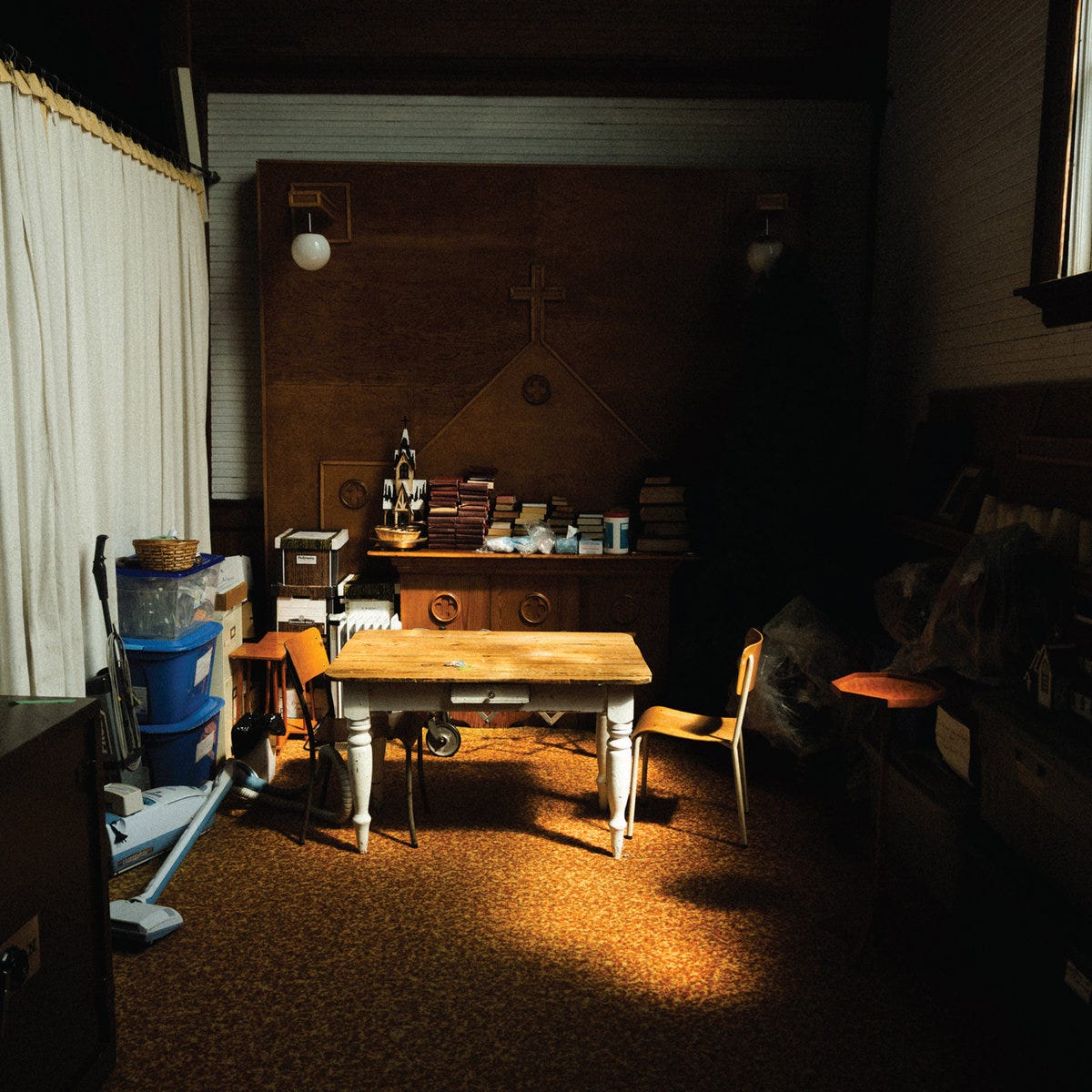
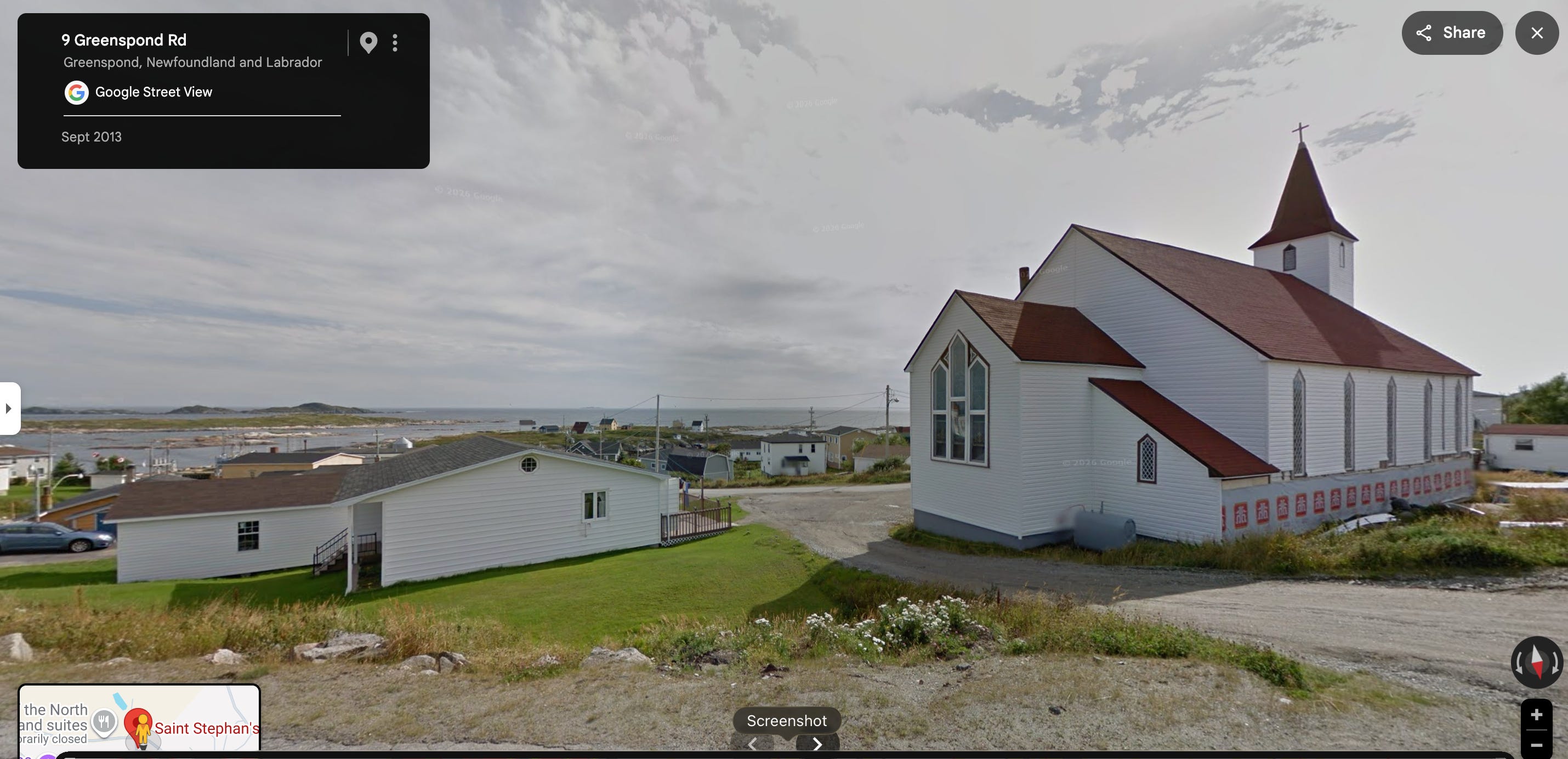
Originating out of a scheme to drive recording engineer Jake Nicolls’ solar-powered, RV-housed recording studio from Newfoundland to Ontario, Kingdom Come, Kingdom Go (out 10 July) is a kind of audio documentary/archive/road movie of the coastal and island settlements of Canada’s far northeast. With composer Michael Cloud Duguay, the idea was hatched to thread their route amongst seven churches located on Newfoundland island and some of the smaller islands off its north Atlantic coast. These were wooden clapboard buildings, with white walls, modest, four-sided spires, unstained glass – perhaps some criss-cross leading and a pointed or arched top to the windows the only adornments marking them as religious buildings.
Inside them, Cloud Duguay, Nicolls and their collaborators Andrew MacKelvie (composer, instrumentalist) and Dave Grenon (field recordist, engineer, co-producer) found organs in a variety of states of repair, from one buried beneath the rubble of deconsecration and abandonment to others updated with amplification and digital keyboards. Whatever their condition, they would record these instruments, as well as the voices of local residents and any other local sounds of interest (nesting birds, creaking pews, whitsling winds, etc). Kingdom Come thus recalls, in its collaging of materials, the sonic documentary work of Luc Ferrari’s Far West News, or (more of a stretch) Matana Roberts’ Coin Coin series – although I don’t hear in Cloud Duguay’s work anything of either the post-serial aesthetic in Ferrari’s work (its attachment to problematising our linear experience of real-world sound), or the use of sonic excavation and cross-pollination as a path to political realisation that is in Roberts’ albums.
What I do hear is something gentler, focused more on letting the instruments, people and places speak than on realising an aesthetic agenda. The album’s eleven tracks don’t so much outline the road trip itself as provide various perspectives on it, highlighting some of the stories it elicited. One of the best, ‘Little Seldom’ (named after a tiny settlement on Fogo Island), preserves a charming improvisation given when the group (joined by Newfoundland violinist Maria Peddle) were met unexpectedly by a small audience at the church. ‘Damnable Island’, by contrast, superimposes a single held note played on all seven organs: I think it’s an E, although with the various tunings, stops and states of repair of each instrument, it’s hard to be sure. Over this shimmeringly dissonant, Radigue-like drone, a local resident talks, in tones equally hopeful and pessimistic, of the precarity of island congregations. In its best moments, Kingdom Come suggests the comfort of community, the pleasure in small things and a humbleness that comes from wide horizons and a challenging environment.
Yet for all the album’s many attractive moments, I found it hard to be genuinely transported by it. There is, despite the stories, despite the specificities of voices and sounds and places, a curious anonymity to the sounds here. As if they have been flattened in production or by composition. Maybe that’s part of the point – when the organs strike up in particularly church-y fashion (as on the second track, ‘River of Ponds’, or the last, ‘Pond 3’), those tiny island churches off the northeast coast of Canada could be almost anywhere around the world. Acknowledging that universality or network of sonic/social connectivity is part of the story, to be sure. Yet I’m reminded of another example of sonic documentary: Annea Lockwood’s Sound Map of the Hudson River. That too combines a kind of universal sound – the movement of water – with the voices and sounds of the people, animals and settlements around it. But Lockwood brings us into those places, by the way she records the sounds of the river (here a trickling stream, there a vast estuary) and by the stories – so connected to the river and its lives – she captures in her interviews. By contrast, there’s a cosiness to Kingdom Come that rubs the edges off what I imagine to be a set of pretty extraordinary locations.
Josh Mason: kicking a dark horse (greyfade)
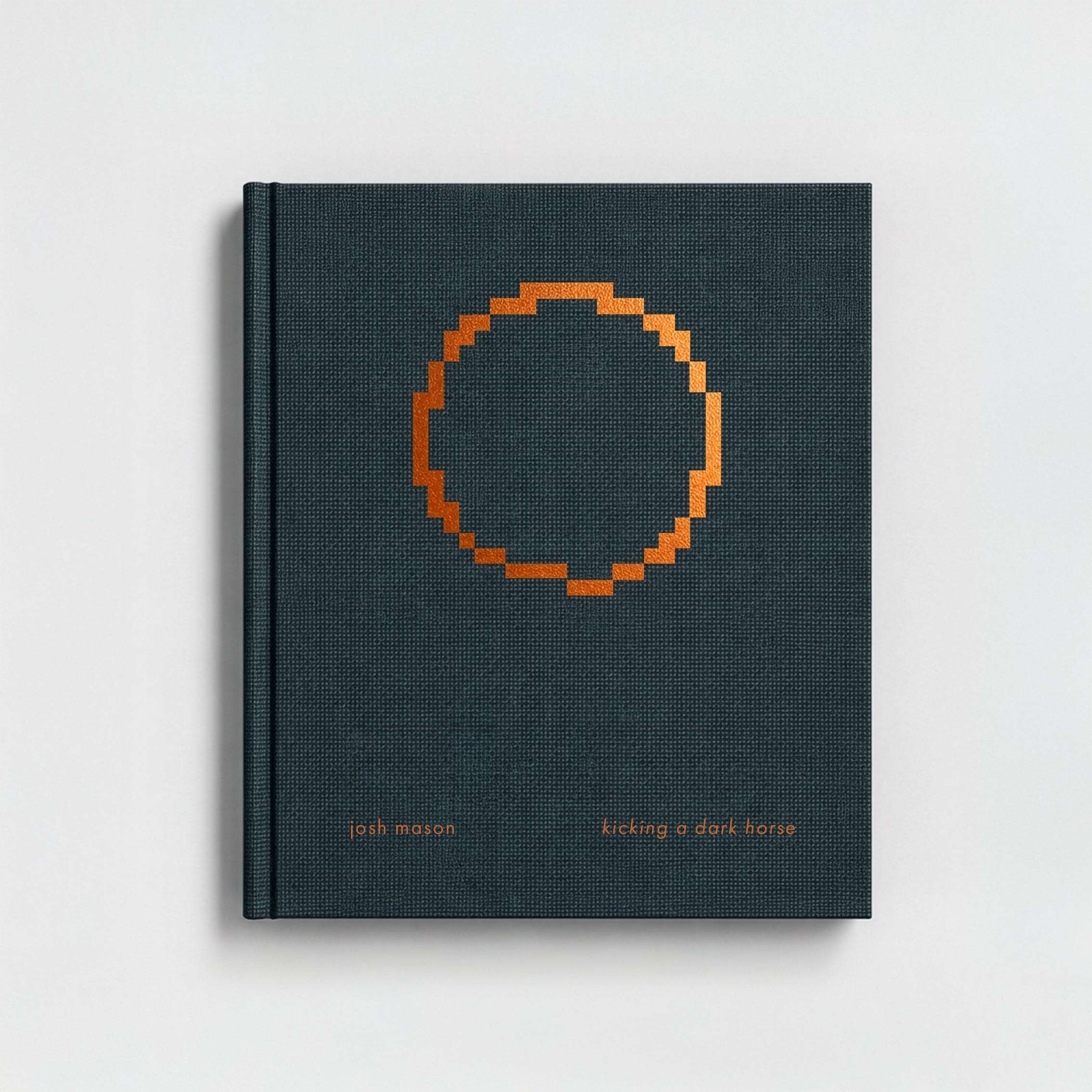
This is the third release in greyfade’s FOLIO imprint, launched in 2024. Starting with Kenneth Kirschner’s three cellos – a transcription by Branciforte for overdubbed cello of Kirschner’s all-electronic July 7, 2010 – the idea behind FOLIO has been to explore the interaction of analogue and digital across both music and media. To this end, all its releases so far (the second was Taylor Deupree’s sti.ll) have been issued in the form of clothbound, hardback books, with the music accessed via a QR code inside. It makes for a dualistic tactile space that feels very contemporary: one chunky in your hands, printed on heavy paper stock; the other requiring almost no tactile engagement at all.
Josh Mason’s kicking a dark horse (out 26 June) may be the most experimental of these releases so far. Whereas three cellos, for example, contained essays by Kirschner, Branciforte and cellist Christopher Gross, for kicking dark horses, Mason has written an experimental, 100-page novella/diary/poem. Fragmented, mixing registers, settings and storylines, it contains memories of home, conversations with family, cloudbursts, bridges, sunlight … Its early recurring images of rain and circuity marry well with the music’s liquid, crackling language. Gently articulated, but detailed enough to hold the attention, this is a beatless space of hums and echoes, shimmering like light on ripples.
Writing sleevenotes, writing programme notes, one dreams of creating a kind of multimedia experience for your reader/listener, in which the two creations dialogue with one another. Realistically, I don’t think that’s ever the case. It’s a difficult thing to pull off, a kind of solitary, internal opera for the home or head. But it seems exactly the kind of thing an imprint like FOLIO is designed for, and Mason has come close to a truly complementary reading/listening experience, in which the music’s recursive structures, its play of artifice and reality are reflected in his text’s collage of cryptic observation, poetry and text messages.
Dialogues: Schubert | Errollyn Wallen (Delphian)
Julien Van Mellaerts, baritone; Dylan Perez, piano
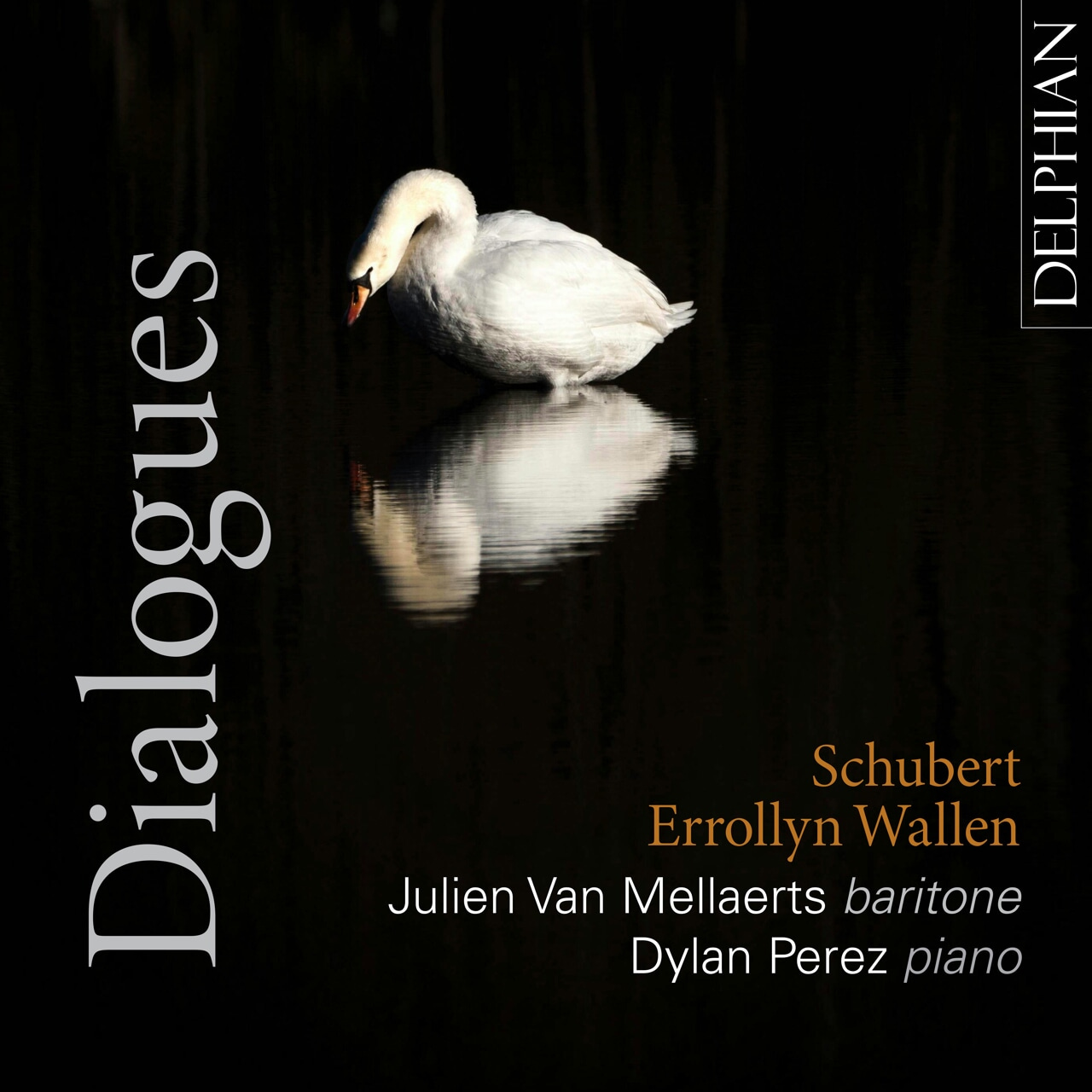
Recital discs that pair Schubert with more modern contributions are hardly rare; only last year, Benjamin Appl recorded a great example, Lines of Life, that brought together Schubert and Kurtág. On the whole, though, those conversations are contrived from a mix of Schubert with existing contemporary compositions, chosen by the performer. I know of one recording, by the Irish pianist Michael McHale, that features pieces by Schubert (the four Impromptus, D899) alternated with three newly commissioned responses (by Simon Connor, Benedict Schlepper-Connolly and Garrett Sholdice). But this pairing of Schubert’s posthumously compiled Schwanengesang and Errollyn Wallen’s The Lake (out 3 July) is the only one I can bring to mind in which both composer and performers have worked together to create not so much a counterpoint or response to Schubert but a genuinely new thing of which his music forms part. I may be wrong, of course – and please let me know in the comments if I am.
The idea came about from the programme that Van Mellaerts and Perez devised for the 2022 Holland Park Opera summer concert series: three cycles by Schubert, each with a twist. For Die schöne Müllerin, Christopher Purves added recitations of the poems Schubert didn’t set; for Winterreise, Roderick Williams sang in an English translation by Jeremy Sams; and for Schwanengesang, a cycle of five songs was commissioned that would reflect on and could be performed alongside the Schubert. The final step, though, was Van Mellaerts’ and Perez’s realisation, on receiving Wallen’s score, that it and the non-narrative Schubert collection could be re-ordered and combined to create a loose story. ‘The whole idea was to reinvent something that we’ve heard a hundred times, and to change the idea of what a Schubert song recital could be’, Van Mellaerts is quoted as saying in Katy Hamilton’s detailed sleevenote.
That story is evidently very flexible: the two performers admit to altering the order of songs almost every time they give them, and this disc is no exception, with the choice being made to begin with Wallen for once, rather than Schubert. ‘I wanted to set up a soundworld that’s different’, is Van Mellaert’s explanation.
In truth, the soundworld of the first of Wallen’s songs is not that far from Schubert’s: hushed, resonant, a simple melody coloured by kaleidoscoping harmonic changes; we are not a million miles away from ‘Ihr Bild’, to come later in the cycle. When Wallen’s ‘The Lake’ is thus followed by Schubert’s ‘Liebesbotschaft’, despite the contrasting effervescence of the latter, the move seems entirely logical. This is a gift Schubert gives to projects like this – so certainly does every song of his establish itself, and with such immediacy – but nevertheless, this is a project whose parts are made to work by connection rather than contrast.
The danger with such interleaving is that the transitions from Schubert back to the contemporary work can be unpleasantly jarring; I feel a little of this with the Appl disc mentioned above: at the very least, ears and mind are made to work harder going from Schubert to Kurtág than vice versa. I don’t know how much thought Wallen gave to this when composing The Lake, but on Dialogues, her music grows just as naturally out of Schubert’s as his sheds illumination on hers. The emergence of her ‘Ready’ out of Schubert’s ‘Kriegers Ahnung’, as if colouring the echoes of the warrior’s anxious cries into the night, is simply gorgeous. The shift in viewpoint, from that of a soldier to that of an uncertain artist, that Wallen’s words provide is pregnant with suggestion. Just as important to effects like these, of course, is Mellaerts’ and Perez’s sequencing, which is throughout attuned to continuities of tone, texture and mood.
There have been musically more radical approaches to this kind of Schubert+ recital; I’m looking forward to hearing how Pierre-Laurent Aimard does it at Aldeburgh next weekend. But few have done it quite as sensitively or as thoughtfully as Wallen, Van Mellaerts and Perez do here.
Writing (and speaking) elsewhere
I had such a lovely time reading from Schubert Dub at this year’s SPARC symposium at City St George’s University. A select but discerning audience, and I was really moved and grateful for the feedback that was offered. Something about the experiences I was sharing seemed to encourage people to open up about their own stories, which I wasn’t expecting and which I found profoundly touching. Thanks to everyone who came; I’m motivated to keep pushing deeper into this stuff.
If you’re coming to the Aldeburgh Festival this year, you’ve got a chance to see/hear me again, when I will be moderating a pre-concert conversation with Ryan Wigglesworth and Lawrence Power about Ryan’s new Viola Concerto, on Saturday 27 June. (I’ll be popping in the previous weekend too, to catch Aimard’s recital of Kurtág and Schubert mentioned above.) Do say hi if you see me.
Elsewhere, I’ve just sent reviews to Gramophone of Robert Laidlow’s forthcoming debut for NMC and Wild Up’s absolutely barnstorming recording of Julius Eastman’s Gay Guerrilla. There was also a programme note for Riot’s Kings Place concert of Martland, Streich and Rzewski: that can be read here (and see also last week’s bonus episode).
I believe there are five Widmann quartets, nos 6-10, all in some way ‘Beethoven-Studien’. (The first five are is some sense also a set.) I know little of his other music… odd, since he’s the third most-performed living composer! (An interesting parlour-game, trying to guess them; I wasn’t entirely surprised at one of the other two, thought the inclusion of the other really a bit iffy; but would’ve have plumped for either…)
Theres a CD with the two Schubert unfinished piano sonatas D 571 and D 840, together with Michael Finnissy’s ‘Vervollständigung von Schuberts D 840’, obviously a completion of the latter Schubert piece - and also Jörg Widmann’s ‘Idyll und Abgrund - sechs Schubert-Reminiszenzen für Klavier’**.
In an elegant tandem to this, Rob Hao’s CD ‘Palimpsest’ features the D 571 and his own completion of it, ‘Palimpsest 571’, along with some more Finnissy, plus works by an Australian composer Alison Kay, along with some Liszt and Chopin.
(** I heard the Juilliard Quartet perform Widmann’s String Quartet no. 8 ‘Beethoven Study III’, together with the Op. 130 to which it responds, at the Wigmore Hall a year or so back. - I think Widmann is doing something very interesting here, but I need to hear more/know more. Perhaps a critic with good ears might help me out here….)