

In the drought and endless heat, the brambles have exploded across the garden. I went out again this week as the sun cooled past the trees to collect more, for the freezer, for winter crumbles, maybe jam. Bittersweet. A gesture towards plenty arising from a moment when, at its darkest, the world seems on a tipping point. What choicer, more nourishing species will brambles outlast, I thought? Will we be picking them in the still longer summers to come?
As I gingerly stretched and plucked, I listened to Peace Anthems, a self-explanatory collection by artists on the Red Hook Records roster. Its ten tracks (Moor Mother, Taylor Deupree, Kit Downes, Wadada Leo Smith, others) met my mood, but raised it too. Earlier in the day, I’d listened, in some discomfort, to Thurston Moore and Bonner Kramer’s They Came Like Swallows: Seven Requiems for the Children of Gaza. Discomfort because the aesthetic pleasure this music was giving me – Moore in ‘Diamond Sea’-esque reflective mode, entwining deliciously with Kramer’s reverb-heavy electronics and soft drum programming – jarred with the implications of the record’s subtitle. In contrast, Peace Anthems is music that does not tell, or even ask; it simply gives. Peace is too obvious a thing to demand; what there is space for, this music says, is the comfort we need as we long for it: the berries to store for later. I listened back to Moore/Kramer with these thoughts in mind, and heard in it a drive, an insistence, that is not in any of Peace Anthems’ tracks. Perhaps there lies the distinction? The plenitude of Peace Anthems, it seems to me, is in its absence of drive, and instead just presence. Like the brambles, it flourishes from darkness. And like them, it gives back.
Recording reviews
Just one this week while I take a short and much-needed break. A few months ago, I wrote a review for the Swedish magazine Nutida musik of George Barton, Siwan Rhys and Taylor MacLennan’s recording for another timbre of the Feldman trios for flute, piano and percussion. That review was published, in Swedish, in issue 304–5 of the magazine. With many thanks to the editors Magnus Bunnskog and Susanne Skog for their permission, here is the English version, slightly amended – including corrections gratefully received in the comments below from Paul Griffiths and, especially, Steven Swartz, who shares some beautiful memories of the first performance of Why Patterns?
Feldman, alone
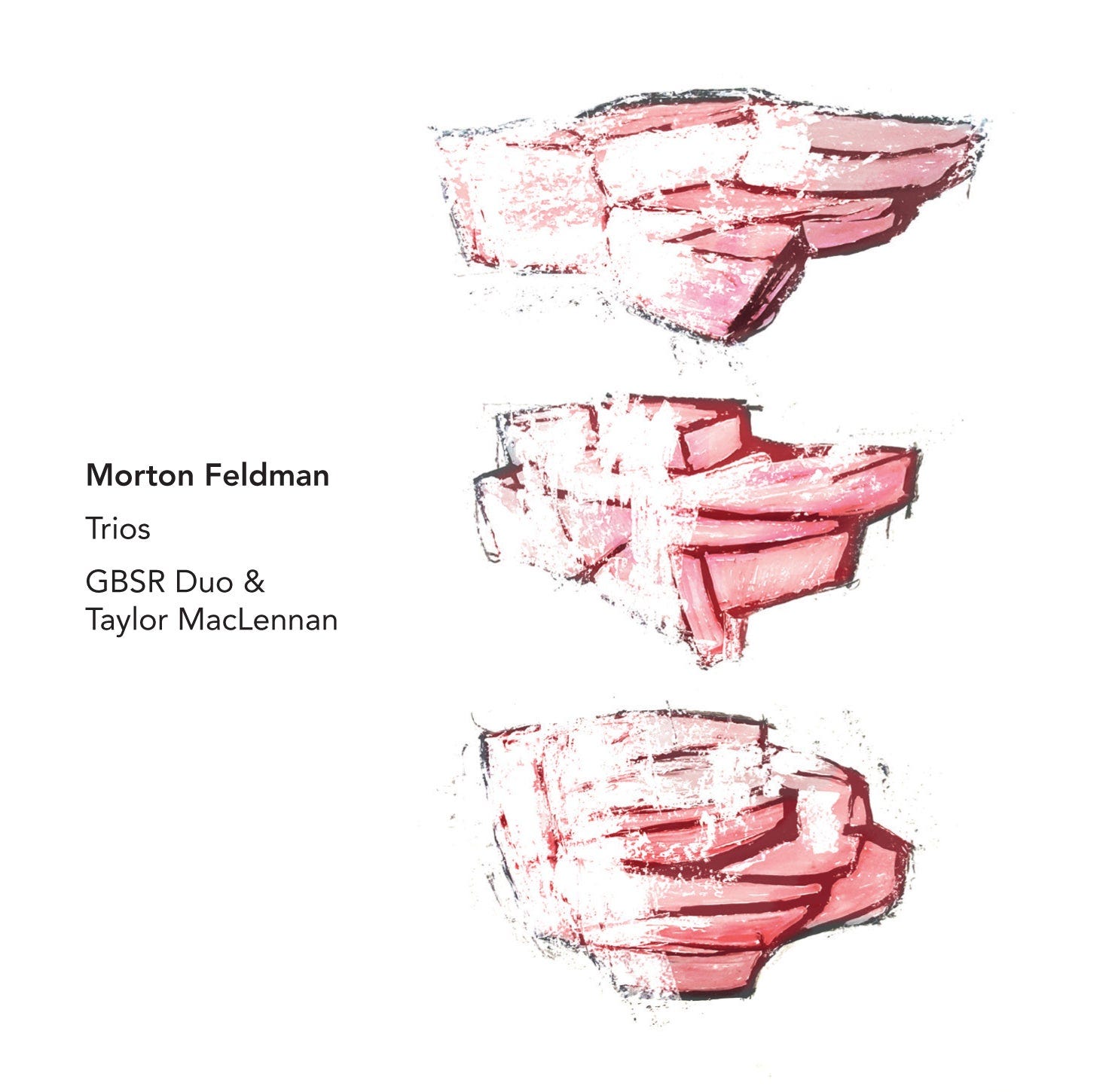
In the late 1970s, Morton Feldman brought together a trio of musicians at the University of Buffalo. Eberhard Blum, flute, Jan Williams, percussion, and Feldman himself on piano comprised a combination of instruments that was unique and yet – in its breathy, shimmering delicacy – uniquely Feldmanian. For the group, Feldman composed a thirty-minute trio, Why Patterns? in 1978. Soon after, his seat in the trio was taken by another Buffalo associate, the recently graduated Niels Vigeland. So much did Feldman like what this group did that he followed Why Patterns? with two even longer works, the ninety-minute Crippled Symmetry in 1983 and the nearly five-hour For Philip Guston in 1984.
With a few decades’ distance, and in this, Feldman’s centenary year, we can see this trio as one of the most important performing partnerships of his career: up there with those he made with the singer Joan La Barbara and even the pianist David Tudor. By their titles alone, these three pieces map almost all of Feldman’s field of exploration. Into them, he poured all the fundamentals of his art.
But they are much more than this, too. Feldman’s evident preference for this group of instruments (apart from two pieces for string quartet, this would be the only chamber line-up he would write for more than once in his prolific last decade) tells us something about the kind of soundworld he had been searching for his entire life. Feldman often spoke of wanting to write a music of tones without beginnings, tones that would come into being just as gently as they would fade out. With the flute, certainly, he found an instrument capable of something close to this. But with piano, celesta and – exclusively, in these three pieces – tuned percussion, he settled on instruments with long decays but pronounced attacks. The tension between the two – that you cannot have one without the other; that there is no sound without bodies – was one of the primary themes of his late music.
Another was the push-and-pull relation that exists between clock time, subjective time and notated time. This was, in fact, a lifelong interest, from the early graphic scores, in which musical events are placed within boxes, to be played within a given time span but no more precisely than that, to works like Five Pianos (1972), in which the five players play every note of their score unsynchronized, timing them only according to how slowly they decay.
In his excellent sleevenote to this new recording of the three trios, percussionist George Barton highlights the importance played by similar processes of synchrony and asynchrony in these three trios. In Why Patterns?, the three parts are precisely notated but not rhythmically related to one another – except for the final pages which, when they lock the three musicians into a surprising alignment, throw into question everything that has come before. A similar strategy is used in Crippled Symmetry (without the concluding synchronization), but with the twist that at two moments the three musicians are given identical music. On the page, it appears that they should be playing in unison, but because of the desynchronization of their parts, they each reach this point at different times, perhaps even minutes apart. And in For Philip Guston, the music unfolds in shorter, periodic waves of synchrony and asynchrony, the three instruments continually coalescing and separating. This piece would be the last time Feldman used such a technique; after it, he wrote only for coordinated ensembles.
It is possible to hear in Why Patterns? and Crippled Symmetry a continuation of that abstract, experimental mode that gave rise to Feldman’s early music. But in For Philip Guston, the subjectivity of time is brought to bear on the subjectivity of human relations. We can hear this in all his late For … pieces, but it is most poignant here in this memorial to his late and long-estranged friend. There is a sad irony in the fact that Feldman and Guston’s friendship ended over the latter’s decision to move away from abstract and towards figurative painting, and that in his reflection on that loss, Feldman came the closest he ever did to musical portraiture. It is impossible not to hear the slow, ever-tentative coming together and moving apart of his three instruments as an expression of regret at this great failing of human connection.
That is what is contained in Feldman’s notation, at least. And with this magnificent, definitive and utterly essential boxset by Barton and pianist Siwan Rhys of the GBSR duo and Explore Ensemble’s flautist Taylor MacLennan, it has been properly realised for the first time. Among the other groups to have committed at least some of this music to disc, only two have tackled all three pieces: the original Morton Feldman and Soloists trio (spread across a pair of Hat ART releases) and the California EAR Unit (across three recordings, variously for New Albion and Bridge). Already, the GBSR/MacLennan recording has an advantage in having been recorded across a single set of sessions and under the same conditions, giving one a unique sense of the lines of development between these pieces.
But it sets new standards beyond this practical distinction. There is a unique balance to how Barton, Rhys and MacLennan play together. Not only balance in the conventional sense of their relative volume (although this is exceptionally well handled by both players and recording engineer Simon Reynell), but also in their negotiation of the line between a group of soloists and an ensemble. Feldman’s dialectic of synchrony and asynchrony depends on this, and it is immaculately managed – through almost super-human levels of concentration, attention and control – across all six of these discs. By comparison, I find the Blum/Eberhard/Williams recordings much flatter and drier, the voices more forcibly separated, as though they were almost playing in defiance of one another. While the EAR recordings are gentler on the whole (although the recording of Crippled Symmetry for Bridge has a harshness to it), there is still little sense of the players thinking not only in terms of their independence but also of what they can bring to an overall group sound.
By contrast, from the very first moments of Why Patterns? one has the sense that Barton, Rhys and MacLennan are not only attending to the phrasing of their individual parts but also have at least one ear on each other to shape larger group gestures or continuities. There is a warmth and a fluidity to their playing – a sense of mutual support and companionship – that I do not hear in the other recordings. For this reason alone, these are the versions of Why Patterns? and Crippled Symmetry I would want to keep. But the trio’s approach becomes truly revelatory on For Philip Guston, to my mind Feldman’s magnum opus.
As the scholar Ryan Dohoney has noted in his book Morton Feldman: Friendship and Mourning in the New York Avant-Garde, the first half of Feldman’s career was defined by its circles of friendship and artistic camaraderie, while the second was defined by their disintegration – whether by death, estrangement or simply the sad distancing effect of age. Feldman, however, seems to have felt this disintegration most acutely: the recurring names in his stories, the succession of pieces written for his friends – all point to this. The loss of Guston seems to have affected him most strongly of all.
None of which is news. But I had not appreciated Feldman’s devastation quite so deeply until I heard these performers play For Philip Guston. There are in this music some of the most subtly constructed passages Feldman ever wrote. But there are an equal number of passages of mind-numbing banality: dumbest of all, those one-note groups of crotchets for flute that crop up from time to time. Yet in MacLennan’s hands these are the truly heartbreaking moments. There is an absolute blankness to them, as if one can feel Feldman’s inspiration draining away from his pen at the prospect of how many hours he still has left to write, how many hundreds of pages. And there is a momentum too, that one feels as MacLennan breathes fully through each note. The heroism of utter despair and of utter resolution. ‘I can’t go on’, as another of his artistic brothers, Samuel Beckett would write. ‘I’ll go on’. God, one mutters to oneself as the CDs continue to spin, Feldman must have been lonely.
Thank you for the most welcome, very perceptive review. (Although my aunt married a Swede, my competence in the language is very minimal…). I’m sorry you weren’t able to include the John Tilbury ‘For Philip Guston’ for comparative purposes - I think John’s touch in Feldman is superlative. (I am also sorry that Another Timbre have yet to assay ‘For Christian Wolff’ - as Tilbury snd Carla Rees have - though I have begun the task of breaking Simon R. to my will…)
Very glad to have this in English! So powerful as it approaches the end. But THE UNNAMABLE ends: "I can't go on. I'll go on." There's lots of "must" before this, but in the second person and seemingly voiced by "words", not "I": "you must go on".