Purposeful Listening 8
Concrete/fantastic

The biggest downside to moving out of London five years ago was the drop-off in my access to live new music. It’s not that London is completely inaccessible – door-to-door, I can be at the Southbank or Barbican in about 90 minutes – but the additional hassle and time (and tiredness) start to add up, and I don’t get to see as much as I’d like. Nevertheless, every new year I resolve to do a bit better than the last. And this year at least has got off to a good start: three concerts in January, all of them different, all of them excellent.
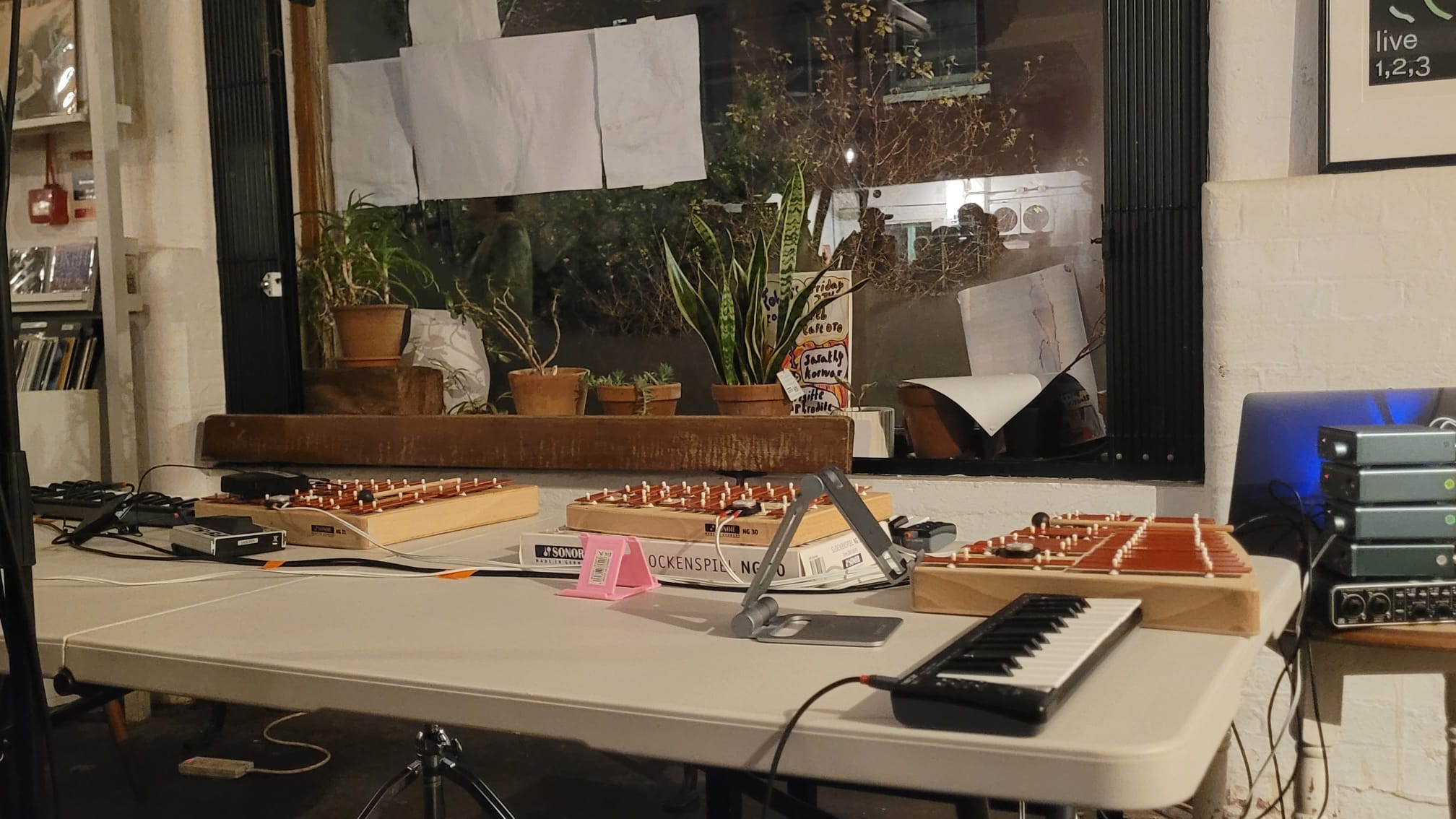
On the 12th, I was at Cafe Oto for the first part of Plus-Minus Ensemble’s three-day residency. It was lovely to see Scenatet play Mads Emil Dreyer’s charming (and ever-so-slightly haunted) Miniature 1 – the forthcoming Dacapo release of which I recently wrote notes for. I’m afraid the urban transcriptions or evocations of Andrea Balency-Béarn’s Mappings passed me by somewhat (the introduction mentioned associations with London and two cities in Mexico, but what exactly those were remained obscure). However, Joanna Bailie’s eerie annotation of/fantasy on a 1946 school photo (rows of bespectacled boys, young survivors of war; all of them now dead, or exceedingly old) was outstanding. Performed by Mark Knoop, it began as a sort of lecture, telling the stories of each face in turn, gradually giving less and less detail until only the close-ups remained – a seemingly endless sequence of faces, each different, each falling into one category or another (hairstyle, expression, facial shape, etc; and behind these, character, class, life story, death). The flat photo, translated into sequence, translated once again into a network of traits. The music, such as it was when Knoop sat down to play, consisted of single piano tones and chords, apparently drawn (in Bailie’s signature fashion) from the background field recording. It didn’t need to be any more than it was; it was enough to elevate what we saw on film and heard in the words out of the realm of the prosaic and into one of poetry that could hold the life of every boy.
On the 18th, I was at Kings Place for Taylor MacLennan, George Barton and Siwan Rhys’s performance of Feldman’s For Philip Guston, the launch event for their superb box set of Feldman trios on Another Timbre. (Look out for a future review of this, location tbc.) This was, as regular readers will know, my third go around this particular ride, and it remains a piece whose overall form continues to elude and elucidate. Perhaps it was the trio’s playing, perhaps it was my own increasing familiarity, but I was struck by the degree to which the four notes of that opening motif reverberate throughout the music’s four-and-a-half hours. They linger, not only as a memory (in a literal sense) but like a memory, rising occasionally to the surface, interbreeding with the present, morphing and fading away once more. They are a bell that Feldman cannot stop from sounding. The other thing I noticed – and this was a virtue of the performance – was how painfully bare some of this music is. I can imagine the temptation, surrounded as this piece so often is with lushly chiming textures, to make it all resound in such a way. But MacLennan, Barton and Rhys were comfortable letting the loneliness at its core bleed through. MacLennan in particular: those passages where he plays plain crotchets, four times on this pitch, four times on this – music with all the subtle ornament of a phone notification – these were brought right to the brink of impotence, an almost complete desire to give up, to give in. And when the last, remorse-steeped section finally arrived, it was MacLennan who stole the show, adding a flowing lyricism to his pairs of notes that made it clear this was a piece for flute as much as the more showy percussion and keyboards. A remarkable afternoon.
And then on the 22nd, I was at the Barbican’s Milton Court to watch the Riot Ensemble play music by Corie Rose Soumah, Anna Meredith, Alex Paxton and Eden Lonsdale. Needless to say, they knocked it out of the park. Meredith’s Brisk Widow, for two drummers, electronics and lighting is thrilling in the flesh (it also, I must say, gained a darker quality that is not always apparent in Meredith’s recordings; something about being enveloped in its incessant ‘up-ness’ became interestingly oppressive). Paxton’s Shrimp BIT Babyface, a Riot co-commission, also gained from being heard live; Riot’s performance was actually less riotous than the version by Nouvel Ensemble Contemporain on New Amsterdam Records. I got a real sense – for the first time, actually – of Paxton’s place in a lineage that goes back through Knussen to Britten and past him to Purcell and beyond. To listen to some of this was to imagine William Lawes as a chiptune composer. The orchestration remains extraordinarily saturated – it is one of Paxton’s gifts to keep so many plates spinning in the air at once – but under Aaron Holloway-Nahum’s conducting, the music acquired a revelatory transparency. I thought I knew this piece pretty well, but I was left thoroughly surprised. The concert was introduced by Aaron as a study in contrasts, the maximalist Meredith and Paxton set off by the more delicate Soumah and Lonsdale on either side. Soumah’s Limpidités IV for the solo violin (and voice) of Marie Schreer was indeed delicate, although verging on the precious. I might need more time with it to get a complete handle on all its subtleties. At the other end, Lonsdale’s Tränen und Ozeane, a work Riot have recently also recorded, was not subtle at all but no less gorgeous for that. An incense-infused mist of bells and fractured organum, it is an utterly beautiful thing, breathtaking in parts; the timing Louise McMonagle gave to her cello’s deep glissandi gave me chills.
Some CD reviews
In this month’s two main PL newsletters, I’ll be giving attention to a few more of the discs released last year that I haven’t yet been able to turn my thoughts to. In between, I’ll also be releasing the next extract from Schubert dub. I’m excited and nervous to see how this lands; it’s different from almost anything else I’ve published, and easily the most intimate thing I’ve written. This one will be available free to all, but from next month extracts will go to paying subscribers only. If you’d like to join them, please click here:
But this week: recordings by Texan multidisciplinary artist TJ Norris, Wales’s own Richard Barrett, Canadian ensemble (and recent Siemens prizewinners) NO HAY BANDA and the second instalment in my year-long project of listening to all of Samuel Vriezen’s 94 Fantasias for algorithmic electronics (first part of that particular journey here).
TJ Norris: Elemental Studies (Carpe Sonum)
It is almost two decades since I reviewed TJ Norris’s triMix CD and DVD on the Rambler; it was actually one of the first discs I wrote about there, and therefore one of the first discs I reviewed anywhere. Nearly twenty years may have passed since, but there are parallels between that album and Norris’s Elemental Studies, released in the last quarter of 2025. Both start from Norris’s films or photographs, both are intensely collaborative and both feature remixes of the original scored works that expand and further document the creative process in the direction of sound.
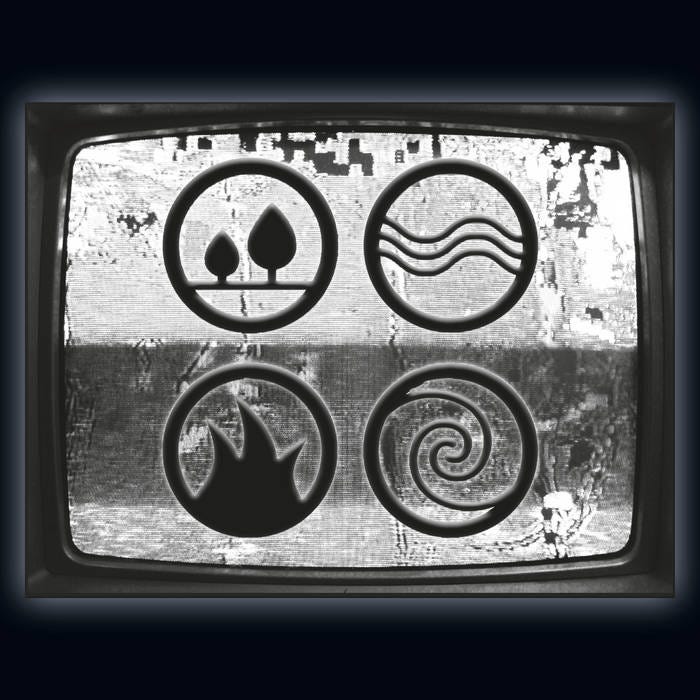
Elemental Studies is based on twelve short black and white films by Norris (see here for a flavour), for which Norris worked with twelve sound artists to produce accompanying electronic scores. These twelve tracks were then each further remixed, and a bonus track (by Sigtryggur Berg Sigmarsson) was added to make a total of twenty-five. I’ll admit, all but one or two of the artists’ names were new to me, but they come from an international roster that includes the likes of Schneider TM, Andrew Lagowski and Hilde Marie Holsen.
Norris presented his films, with their accompanying soundtracks, as a four-channel installation in various venues towards the end of last year. Those films aren’t made available on the CD or download versions of the album; instead, this is a musical release in its own right, and I will review it as such. It is enough to know that the original films dealt, in abstract terms, with ecological challenge and change, through the symbology of the four elements: air, fire, water and earth. The elemental focus of many of the tracks can be intuited from their titles (‘Ventilate’, ‘Flare’, ‘Flow’, ‘Landmass’), but not so straightforwardly from their sounds, which range from the aggressive glitches of Jos Smolder’s ‘Airborn’ to the Pan Sonic-esque bass static of Porya Hatami’s ‘Lumière’ to the deeply resonating synth pads of Mick Chillage’s ‘Blaze’ to the sawtooth drones of Illusion of Safety’s ‘Adrift’. There are some commonalities, though: similarly to Norris’s films, the foregrounds are distorted, often abrasive, overlaid with static and other interference, but behind that screen are suggestions of nostalgia, of lost sentiments, of a reality that is falling out of reach. (I couldn’t tell for sure, but I feel like there are a lot of highly processed concrete sounds across the disc as a whole.) The remixes, meanwhile, push that sense of the real and the fantastical – the point within the climate crisis where one terrifyingly becomes the other – still further, using relistening and remaking to centre what was previously on the margins. The last two tracks deliver a satisfying one-two that further opens up the field: first Mariuca Garcia-Iomas’s Counter Current (after Massimo Toniutti) introduces Glass-esque bip-bopping clarinets (perhaps the first recognisably acoustic instruments of the disc?), before Marja-Leena Sillanpää’s Wake (up) (after Andrew Lagowski) rounds things off with two minutes of fully saturated noise, an ending that recalls in its absolute devastation the final track from Natasha Barrett’s Toxic Colour, albeit more succinctly expressed. This is not an album I can imagine putting on for pure pleasure, but as a headphone soundtrack for one’s own private investigations, it is pure cinema.
Zihua Tan/NO HAY BANDA: what comes before me is going after me (no hay discos)
Coinciding with NO HAY BANDA’s recent Ernst von Siemens Ensemble Prize is this disc of music by the Malaysian-born, Montreal-based composer Zihua Tan. It features two works, the thirty-minute titular piece for voice, violin, cello, percussion and Ondes Martenot; and the sixteen-minute remnants present for solo percussion, played brilliantly by Noam Bierstone, who also worked closely with the composer in developing its unique and striking soundworld.
With Bierstone’s help, Tan was drawn to explore ‘a world of complex, delicate and fascinatingly volatile sounds that seem to be latent in the instruments themselves, waiting to be discovered, to be articulated’, he is quoted as saying in the accompanying press materials. ‘What if these delicate sounds – these shadowy remnants that seem to trail behind more weighty sounds – do not emerge from the fading of something, and both – the light and the shadow – are present since the very beginning? If the remnants are unveiled at the foreground, what, then, slips to the background?’
The focus then seems to be on resonance and reverberation. But, as Feldman shows us, it is not possible to have a decay without an attack. There is no resonance without a body to make that first sonance. Thus it is that Tan speaks also of not playing on the gongs, but playing with the gongs. In remnants present, gongs (and later congas) are made to sound in ways that make as little of the attack as possible, but that keep the sound internally alive and variegated. So metal objects are drawn across the gongs’ rippled surfaces using magnets; spring doorstops are twanged on the skin of the drums. Attack and resonance become almost one and the same thing. There is no striking of instruments, only ways of being alongside them.
The longer title track transplants these ideas into a richer ensemble context, where they are less immediately apparent (it is possible to think of the first piece as a sort of study for the second) but also more richly realised. For the attack/decay dynamic of remnants present, substitute the pairing of melodic-harmonic foreground and timbre/noise background. By writing a ‘background’ that is continually fascinating, Tan is able to make it a foreground; in turn, the moments of ‘foreground’ melodic gesture – the interjections of the voice or Ondes, say – become transitory and ephemeral.
Tan’s name is relatively new to me, although he has already built up an impressive CV of performances and relationships across Europe and North America. And this debut album is a stunning release. In trying to place it, I hear overlaps with the determinedly physical music of Pierluigi Billone, say, but within a non-recursive formal flow more like that of the post-AMM improv tradition. Yet that doesn’t capture it either – there are clearly staged, intentionally dramatic moments in both pieces that speak to their carefully constructed nature. The last third of what came before … in particular takes a turn into some pretty unexpected territory; Tan is evidently a composer not content to rest easily on what is already done.
Samuel Vriezen: 94 Fantasias for 31 voices (tracks 17–32)
It has already been two-and-a-half months since I last checked in on Samuel Vriezen’s year-long ‘growing album’ project. I said an update would come in January, and it’s still just about January as I write, so that counts. (This is called ‘author’s maths’.) In contrast, Vriezen is sticking to his words and is already halfway through composing and publishing the complete set. Hopefully I will catch up to him at some point, but we shall see.
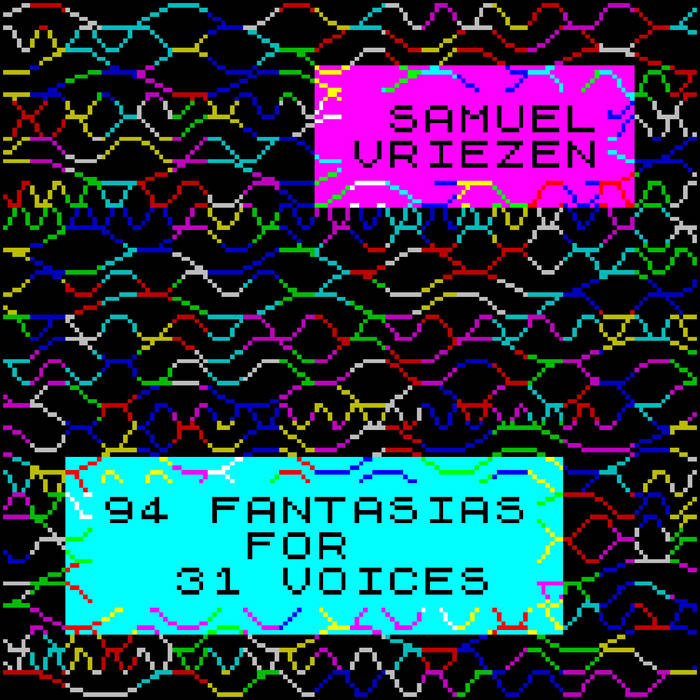
As a reminder, and as I described in my review of the tracks 1–16, the 94 Fantasias is a year-long project to compose ninety-four short pieces for thirty-one electronic voices, and to release them as recordings on Bandcamp at a rate of two per week. The first, No. 1 – Noon (for Hannah), was composed as a birthday gift for the poet Hannah van Binsbergen; the rest have emerged as further iterations or extensions. Each fantasia has the same form: thirty-one voices, each comprised of thirty-one notes; each voice that enters in turn produces another beginning either a fifth above or a fifth below. The music is produced algorithmically using a C++ program written by the composer, giving it certain parameters but for the most part letting the music do what it will. The voices are imitative, but the algorithm allows them to diverge from the original theme to greater or lesser degrees.
This sextant of the ninety-four begins with an accidental memorial, and a work that counts as one of the more immediately evocative of the set so far. Vriezen chooses his titles after the music has been generated, and No. 17 – Dark Landscape (To Lynch) originally acquired its name in recognition of the way its twangy guitar-like sounds share space with Antonio Badalamenti’s famous score for Twin Peaks. The accident is that just weeks after the music was generated, Lynch himself passed away. At nearly fifteen minutes, it’s one of the longer examples too, and features an extended coda as the slower, later voices gradually wind themselves down.
In the general spirit of gameplay, I’m going to adopt a policy in these reviews of not re-listening to tracks released before the ones under review, but to rely instead on my earlier write-ups as a basis for comparison. With that in mind, these sixteen strike me as more poetic than the last appear to have done. Perhaps the shock has worn off a little, perhaps I am slightly more familiar with the language. But I think, too, there is something more approachable about these – perhaps Vriezen has also become more practised in this world he is making for himself? And so we can say that No. 65 – Aglow is positively jubilant in its upward leaps onto consonant intervals and chords; that No. 48 – Shadow Play makes notable use of dynamics to create a flickering, shadowy world; and that the sharply descending contours of No. 7 – Snow gradually combine to capture the whirl of falling flakes. A pair of laments, No. 59 – Laments II (Low) and No. 46 – Laments I (High), also touch a powerful emotional chord, and are possibly my favourites of the set: one a long groan, the other a keening that ends in a sigh.
Dear Tim, How old do you have to be to qualify as "exceedingly old"? Just wondeering. No reason. Yours, Paul Griffiths (78)