Purposeful Listening 2a
Moment/decay, energy/frame, algorithm/emotion


My original intention had been to include the three reviews below at the end of last week’s Stephanie Lamprea interview, but with that taking up more screen space than I had anticipated, I thought I would do tired eyes a favour and save them for a separate issue. Hence, this bonus issue!
Here, then, is a pair of reviews of CDs recently released by Sheffield’s another timbre (a third, Antti Tolvi’s chopped and screwed recording of Feldman’s Intermission 6, will receive the deep-dive treatment next week). These come from at’s most recent batch of five, which also includes recordings by Sara Cubarsi and Xenia Gogu of Marc Sabat’s Bach Tunings and Magnus Granberg’s The Willow Bends and So Do I. Those two albums I thought would receive more coverage elsewhere, though, so I’ve picked those by Julia Eckhardt and James Opstad to focus on here.
I follow those up with the first instalment of a (hopefully) six-part sequential review of Samuel Vriezen’s idiosyncratic, algorithmic 94 Fantasias for electronics that I will be dipping in and out of over the next year.
James Opstad: Drift (another timbre)
We were talking the other day about musical mobiles. And here is a case in point, by Stroud-based composer and bassist James Opstad. All five of the works here – which range from a pair of short Studies for string quartet to the 22-minute title work, for clarinet, piano and temple blocks – establish their materials pretty swiftly, and then go through various processes that show that material in ever-changing configurations.
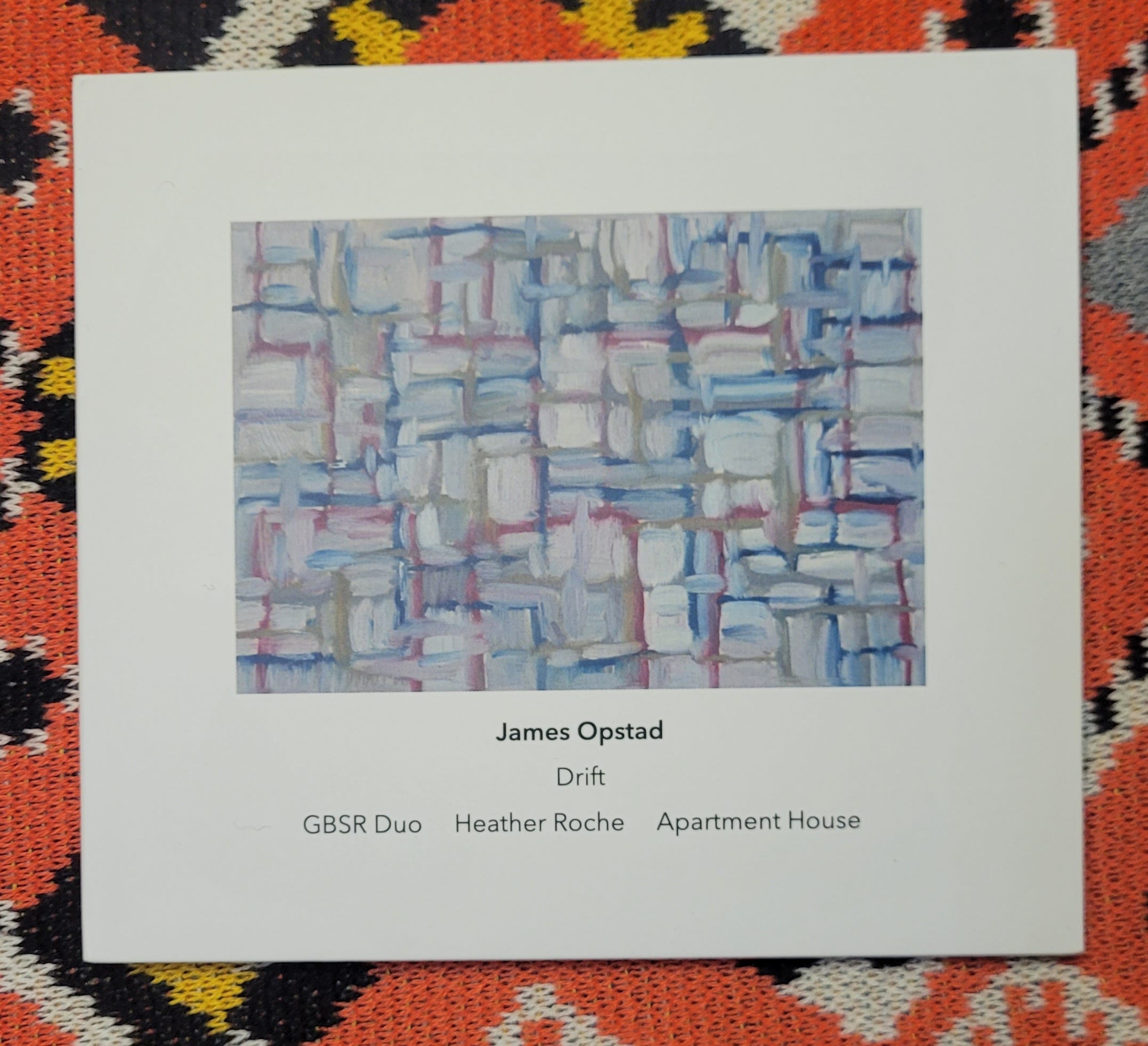
There’s another theme present – one to which I will be giving more attention in future posts – in the way that unfurling temporal relations interact with conditions of duration and decay. Opening track Nymphaea, for piano and vibraphone, is a study in such decays, the ear being drawn into following the afterglow of hushed chords that are either interrupted or allowed to sound by the shifting rhythms between the two instruments. Eluvium for clarinet and tam-tam – the earliest work here, dating to 2018 (and a piece that the composer, in this interview on the another timbre website, describes as ‘a precursor of the rest of the music on the album, not only because of a renewed focus on pitch, but also because of the layering of different tempi’) – involves a live feedback process in which the clarinet is recorded and played back through a speaker placed behind a tam-tam. In an Alvin Lucier-ish way, the resonant frequencies of the tam-tam slowly accumulate, gradually engulfing the clarinet even as it multiplies itself over loops of tape. The materials – the reverberation of natural instruments – remain the same, but the effect is one of accumulation and, paradoxically, simultaneously, erasure.
In both cases, though, the music is really about a process of de-homogenisation that derives from the materials of the music itself. Drift – a work interrupted for several years by the pandemic, fertility treatment and the birth of Opstad’s daughter – takes this concept to a greater length, assigning each instrument to its own tempo, which is then gradually slowed across the work’s length. The three instruments begin by occupying complementary, if different, spaces within a single texture, but as gaps between them open up, the ear is granted enough time to pass from one to the other, considering each in turn. If the result recalls the work of other composers more than the other pieces here (the time-stretched glitterball soundworld bears more than a passing resemblance to the music of Bryn Harrison, and the looping piano and clarinet can’t help but recall the ‘Liturgie du cristal’ from Messiaen’s Quatuor pour le fin du temps either), that is compensated by the sheer loveliness of the textures.
Overall, this is an exciting debut from a young composer. As one would expect, the players – Apartment House, GBSR Duo (Siwan Rhys, piano and George Barton, percussion) and Heather Roche, clarinet – cannot be faulted in their commitment to its vision.
Julia Eckhardt: Blanca (another timbre)
another timbre releases are typically pretty minimalist productions. It’s very unusual to find a pull-out booklet inside the sleeve of one of its CDs. Julia Eckhardt’s Blanca comes with just such a pamphlet: of photos – eight in all, each one of a square of ground, taken directly from above. The composition of some of these – two pieces of discarded pomegranate, a stack of overlapping strips of bark, a heap of leaves against the corner of a wall – makes one suspect a guiding hand behind what is on display. Others, though, are relatively featureless, simply surfaces held within the camera’s frame.
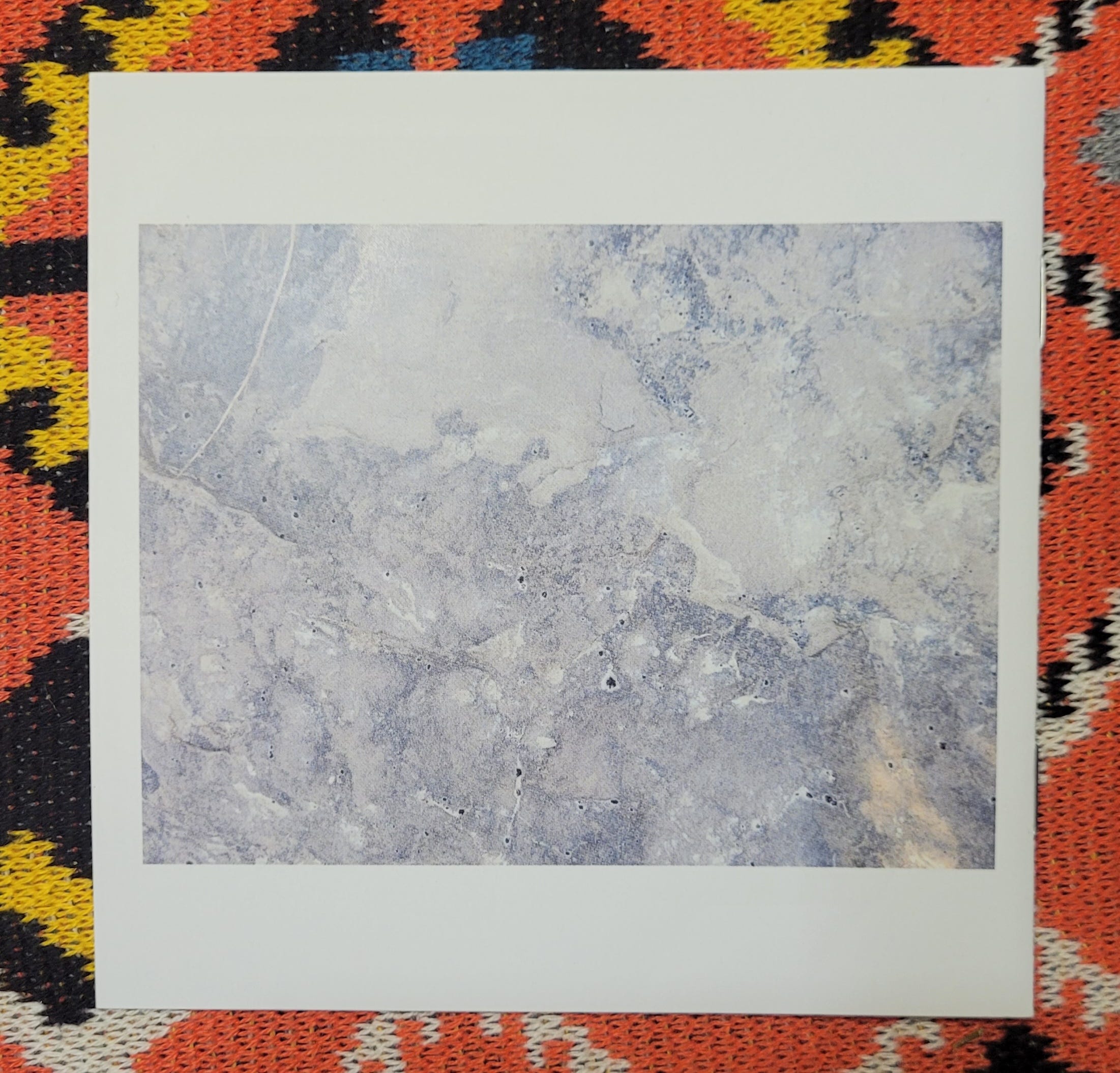
The reason the photos are here is explained in the short note Eckhardt provides on the album’s inner sleeve (also unusual, but not quite as rare). While on an artist’s residency at Centro Negra in the small town of Blanca in southeast Spain, she undertook a daily ritual of walking ‘without plan or destination’ in the local hills, taking a photograph and making a field recording. On returning, she recorded an improvisation on her viola, ‘echoing the energy of that accidental place’. One is led to assume that the eight photos in this booklet correspond to the eight tracks on the CD – air; patterns, slow; clouds swirling; levity; wind (figures); circular; starling murmurations; wind again – although it is hard to grasp any obvious connection. And what of the ninth photo, included on the inside sleeve? (The landscape shot on the album’s cover is clearly of a different order, so I do not include it among them.)
As a regular performer of and collaborator with artists such as Éliane Radigue and Manfred Werder, Eckhardt is no stranger to channelling obscure links between places, sounds and moments. The mysterious linkages between the various wings of her Blanca project – the walks, the photographs, the field recordings (preserved here only in the closing moments of the last piece), the improvisations – are partly the point. The way the energy of a place manifests – and Eckhardt notes specifically the quality of the wind on her walks – is different for the twigs, leaves and pebbles of her photographs than it is for her recalled evocations on the bow and string of her viola.
That music is obviously in the lineage of Radigue, or perhaps of Werder’s Wandelweiser colleague Jürg Frey – droning whistle tones, sibilance at the edge of pitch, the slow teasing out of upper partials. But it is also briskly and precisely articulated. The almost bagatelle-like nature of the pieces – which could, in other hands, have been drawn out for much longer – is part of their charm. Like the photos, each selects and frames its image, and then moves on. Eckhardt has loosely notated the results of her improvisations, though more as an aide-mémoire than as way to communicate them to other players. I feel within them the very antithesis of masterpiece-thinking: Eckhardt simply records the dignity of small things before leaving them be once more.
Samuel Vriezen: 94 Fantasias for 31 voices (tracks 1–16)
At the end of August, the Dutch poet, composer and pianist Samuel Vriezen began a year-long project to compose 94 fantasias for 31 electronic voices, releasing them as recordings on Bandcamp at a rate of two per week. The first, No. 1 – Noon (for Hannah), was composed as a birthday gift for the poet Hannah van Binsbergen; the rest have emerged as further iterations or extensions of that original piece. There isn’t really a name for what this is. Vriezen labels it on Bandcamp as a ‘growing album’, which I like; but I like more his discovery of something that breaks the available categories of nomenclature and distribution. Vriezen himself describes the Fantasias as ‘a first experiment in composing for streaming services’. Indeed, they serve in part as studies for a larger, yet-to-be-written twenty-four-hour work that will be published in instalments through 2027.
In honour of that ideal, at the very least, I will be returning to the collection every couple of months to give the next sixteen or so tracks a listen, and to report back here. But first, a little background.
Twelve years ago, Vriezen recorded a remarkable version of Tom Johnson’s The Chord Catalogue for Edition Wandelweiser, a catalogue of all the possible one-, two-, three- … thirteen-note chords available within a given octave, played in strictly organised sequence (the 78 two-note chords, the 286 three-note chords, the 715 four-note chords … the one thirteen-note chord), played with such a brisk, light touch it seemed only peripherally pedantic, and fundamentally curious and delighted.
Vriezen’s recording was partnered with his own tribute to Johnson, Within Fourths/Within Fifths – a related exploration of melodic possibilities within restricted gamuts – and there is a hint of Johnson in the idea behind the 94 Fantasias. (No. 100 – Sweet Songs, Bye-Bye Tom is dedicated to the American composer, who died at the end of 2024.1) Here’s Vriezen’s own description of that piece:
Technically, each of these works has the same form: 31 voices enter, each will play 31 notes. The first voice starts solo; every voice produces a voice that answers in the upper fifth or the lower fifth. So the first voice summons two counterpoints; these summon four more; these eight more; these sixteen more; for a total of thirty-one voices. Later voices tend to be slower than earlier ones, giving each work a clear shape: theme – buildup of massive counterpoint – slow, thinner coda, sometimes ending in a long solo.
Vriezen uses an algorithmic process (no AI, just some C++ coding written by the composer) to generate the music, giving it certain parameters but otherwise letting the music bloom however the computer seeds it. (One example being the one perfect fifth he insists is part of the harmonic language, leaving the rest up to the computer.)
But there is also more than a hint of something older: the contrapuntal fantasias of the European Renaissance and Baroque: Byrd, Sweelinck, Purcell; the English In nomine tradition; puzzle canons; A Musical Offering and The Art of Fugue.
None of which is to prepare one’s ears for the results. Vriezen’s chosen sound source – a sawtooth analogue(?) synth, microtonally tuned – is not designed for passive or extended listening. It doesn’t charm in the way that Johnson’s music typically does, even if it does foreground a shared eccentricity. Given the emphasis placed by the composer on the strict contrapuntal construction of this music, it may seem strange to begin with the music’s timbre; yet it is the first thing that one is struck by, and the thing about it that endures, whether the eerie interference patterns of pitch and dynamic that project out from the music as more voices are added, or the ghostly glitching that occurs as the slower voices run their course towards the ends of each piece. Unlike a contrapuntal fantasia of Bach or Purcell – in which one can marvel at how the music threads the needle between pre-compositional determinacy and seemingly spontaneous emotion – the absence of a common harmonic/contrapuntal grammar makes that rather redundant. One marvels instead at the sheer oddness of the results; but this is not to say that there aren’t moments of humour (No. 61 – Multiball!!!, with its evocation of pinball arcade games), emotion (the above-mentioned tribute to Tom Johnson) or historical allusion (No. 30 – Intermezzo (To Brahms), whose falling thirds remind Vriezen of Brahms’s Intermezzo Op. 119, no.1). A favourite is No. 12 – Deep Earth Songs, whose large, plunging intervals create an unusually spacious texture and a deep, rumbling atmosphere. The works being composed algorithmically, of course, the titles come after composition, in response to what the computer has proposed. Charmingly, Vriezen provides a short note for each Fantasia on its individual Bandcamp page. More thoughts from me, focusing on releases 17–32, will follow in January.
It’s worth noting that the numbers Vriezen assigns to his Fantasias do not correspond to the order in which they are being released. Neither, as this example proves, do they necessarily correspond to their being just 94 of them.